Jetta's First Electric Sedan Lands at 79,800 Yuan as BYD's Seagull Grows Up
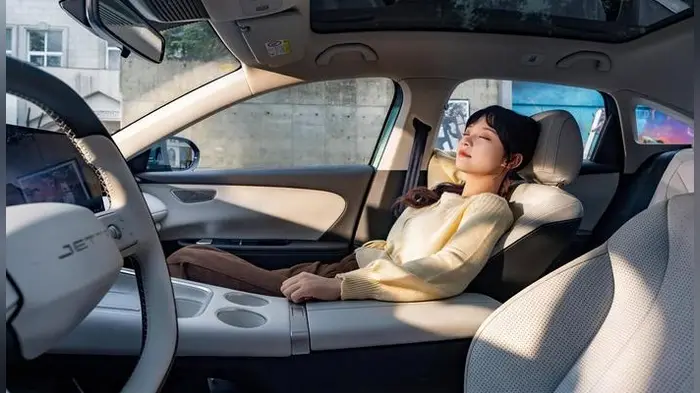
China’s car market rarely pauses, and this week’s launch round-up shows how crowded even the cheapest end of it has become. The headline arrival is the Jetta M6, the first fully electric sedan from the Jetta brand — a marque that began as a single model name under the FAW-Volkswagen joint venture and was later spun out as a budget label. The M6 goes on sale in three versions priced between 79,800 and 99,800 yuan, roughly 11,000 to 14,000 US dollars, and sits on a dedicated electric platform the brand calls Jetta Electric. Buyers get lifetime warranty on the battery, motor and control electronics, plus original parts coverage — a reassurance play aimed squarely at first-time EV owners who worry about long-term costs.
Visually, the M6 follows the template now standard for Chinese electric sedans: a closed-off front face with no radiator grille, slim light units and a light bar running across the nose. It is a mid-size car by Chinese classification, which means rear-seat space is a selling point rather than an afterthought. The message is simple — Jetta, long the value badge in the Volkswagen group’s China line-up, intends to keep that position in the electric age rather than retreat upmarket.
At the other end of the price ladder, BYD has updated its Seagull, the tiny hatchback that has become one of the cheapest ways into electric driving in China. The new version moves to a five-seat layout, a small but meaningful change for a car whose rear bench was previously rated for two. For urban families treating a subcompact EV as the household’s only car, that extra belt changes the buying calculation more than any spec-sheet number.
Elsewhere in the week’s batch, BAIC’s new Xingtan model opened pre-sales from 139,900 yuan, and Roewe’s Jiayue 07 sedan introduced a cabin assistant built on Doubao, the large language model developed by ByteDance. Voice control has become the front line of competition in Chinese car interiors, with automakers racing to put a conversational assistant on the dashboard rather than a menu of fixed commands.
The pattern across all four cars is a market that keeps pushing features downward. A decade ago, a sub-100,000-yuan sedan was basic transport; today the same money buys a purpose-built electric platform, lifetime drivetrain warranty and a screen that talks back. That compression is why foreign-brand joint ventures such as FAW-Volkswagen are using sub-brands like Jetta to fight domestic giants on price, and why those domestic giants keep refreshing entry models before rivals can catch up.
For global readers, the week is a useful snapshot of how fast Chinese product cycles run. Launches arrive in clusters, often several in a single week, each aimed at a narrow price band. The Jetta M6 will be judged on whether a European badge still carries weight at 80,000 yuan; the Seagull on whether five seats turn a city runabout into a family car. Both answers will shape what the next batch looks like.