Unitree's Stock Rebounds 70% Even as Its First Earnings Report Disappoints
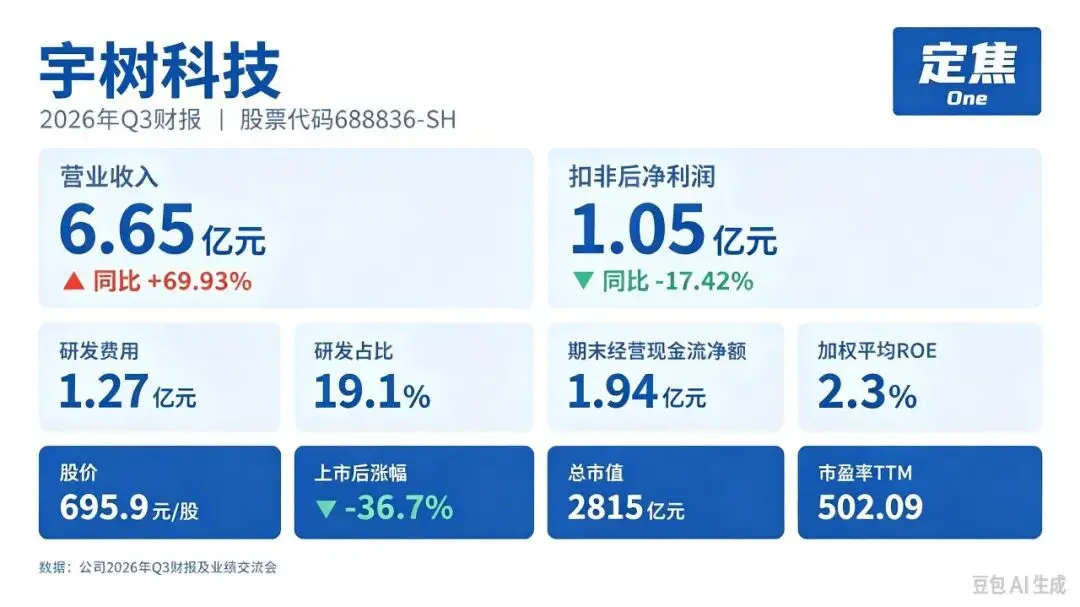
Unitree Robotics, the Hangzhou-based maker of quadruped and humanoid robots, has spent the past 12 trading days doing something its first earnings report did not: impressing investors. The stock has risen more than 70% in that stretch, pushing its total market value back above 280 billion yuan, according to Chinese tech and finance outlets. That is still roughly 150 billion yuan below where the shares opened on their first day of trading.
The rebound makes the company’s first quarterly report since listing, released after the market closed on October 28, look almost deliberately modest. Revenue for the quarter came in at 665 million yuan, up 69.93% from a year earlier and a modest reacceleration from earlier growth rates. Adjusted net profit, which strips out one-off items, was 105 million yuan, down 17.42% year on year.
The split between the top and bottom lines has a simple explanation: Unitree has been spending heavily on research and development this year. For a company whose pitch to public markets rests on embodied AI — the idea that robots will soon learn to handle physical tasks the way chatbots handle text — that is not necessarily bad news. Building a robot that can walk, balance and manipulate objects is expensive, and the spending is the point.
What is less clear is why the stock needed a 70% rally to get back near its listing-day opening. Unitree arrived on the market as one of the most anticipated Chinese listings of the year, riding a global wave of interest in humanoid robots. Since then, investors have had to weigh that enthusiasm against the slower, messier reality of turning prototypes into products with reliable margins.
The company’s humanoid line has drawn attention for its public demonstrations and relatively aggressive pricing, and it has been positioning itself as a supplier of robot hardware rather than only a showcase. But the earnings show that revenue growth is still being bought partly with higher costs. A 69.93% revenue increase is strong by almost any standard; a falling adjusted profit alongside it is the kind of combination that makes investors ask how long the spending phase will last.
The broader context is a Chinese robotics sector that has attracted enormous capital and public attention in 2026. Humanoid robots have become a fixture of trade shows and stock-market narratives, and Unitree is among the most visible names in that group. Its share performance therefore carries weight beyond the company itself: it is one of the few pure-play listed ways for investors to bet on the embodied-AI theme.
For now, the market has chosen to look past the profit decline. The next test will be whether Unitree can keep revenue growing fast enough to justify the research budget, and whether its humanoid products start contributing meaningful sales rather than headlines. The stock’s 12-day run suggests investors believe both are possible. The quarterly numbers suggest the company is not there yet.
A global reader should note that this is a young public company in a young industry, and its early quarters will be volatile. The 70% rally and the 17.42% profit decline are not contradictory so much as a reminder that in embodied AI, investors are paying for a future that the income statement has not yet learned to describe.