China's Motorcycle Market Rides Back After a 20-Year Slide
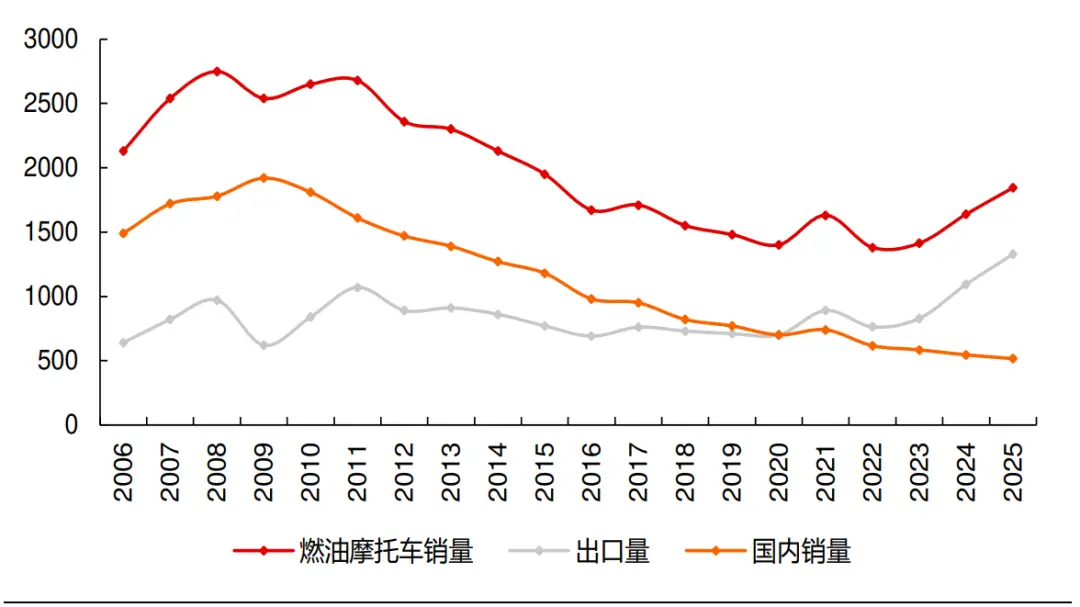
For two decades, the Chinese motorcycle looked like a fading business. Domestic sales peaked at 27.5 million units in 2008 and then slid year after year, squeezed by city restrictions on motorcycles and by a growing appetite for cars and electric two-wheelers. Analysts and industry veterans wrote the category off as a relic of a poorer era.
This year the numbers tell a different story. In the first half of 2026, sales of fuel motorcycles inside China reached 2.6496 million units, up 2.09 percent year on year, according to industry data. That is a modest gain, but it marks a reversal in a market that had been shrinking for so long that few expected it to grow at all.
The real engine is exports. When overseas shipments are added, total industry sales of fuel motorcycles came to 10.1724 million units in January to June, an increase of 12.44 percent from a year earlier. In other words, Chinese motorcycle makers are now selling roughly four bikes abroad for every one they sell at home, a ratio that would have seemed implausible during the domestic boom years.
The export surge reflects a broader shift in Chinese manufacturing. Domestic brands that once competed mainly on price have spent years building up engine technology, design and quality control, and they are now pushing into Southeast Asia, Latin America, Africa and parts of Europe. Many of those markets have large, young populations and weak public transport outside major cities, making affordable two-wheelers a practical necessity rather than a hobby.
At home, the picture is more complicated. Major cities still restrict where motorcycles can be ridden, and the rise of electric scooters and shared bikes has taken a chunk of short-distance travel. The domestic market that remains is increasingly skewed toward leisure riding, premium models and rural areas where a motorcycle is still the most useful vehicle a household can own.
The recovery is not evenly spread. Growth in the domestic market is thin, and the industry remains highly fragmented, with many small makers fighting for thin margins. Export demand can also be volatile, shaped by currency swings, shipping costs and the health of buyer economies. A single strong half-year does not undo nearly two decades of decline.
Still, the direction of travel matters. A category that was widely seen as structurally doomed is showing that mature manufacturing industries can find new life by looking outward. Chinese motorcycle makers have spent the past 20 years being written off; the next few years will test whether they can turn an export boom into a durable global brand presence.
For global readers, the story is a reminder that China’s industrial base is broader than the headlines about electric vehicles and batteries. Motorcycles, like appliances and solar panels before them, are another sector where Chinese firms have quietly built scale and are now competing abroad.