Nobel Physics Prize Goes to a Telescope Made of Antarctic Ice
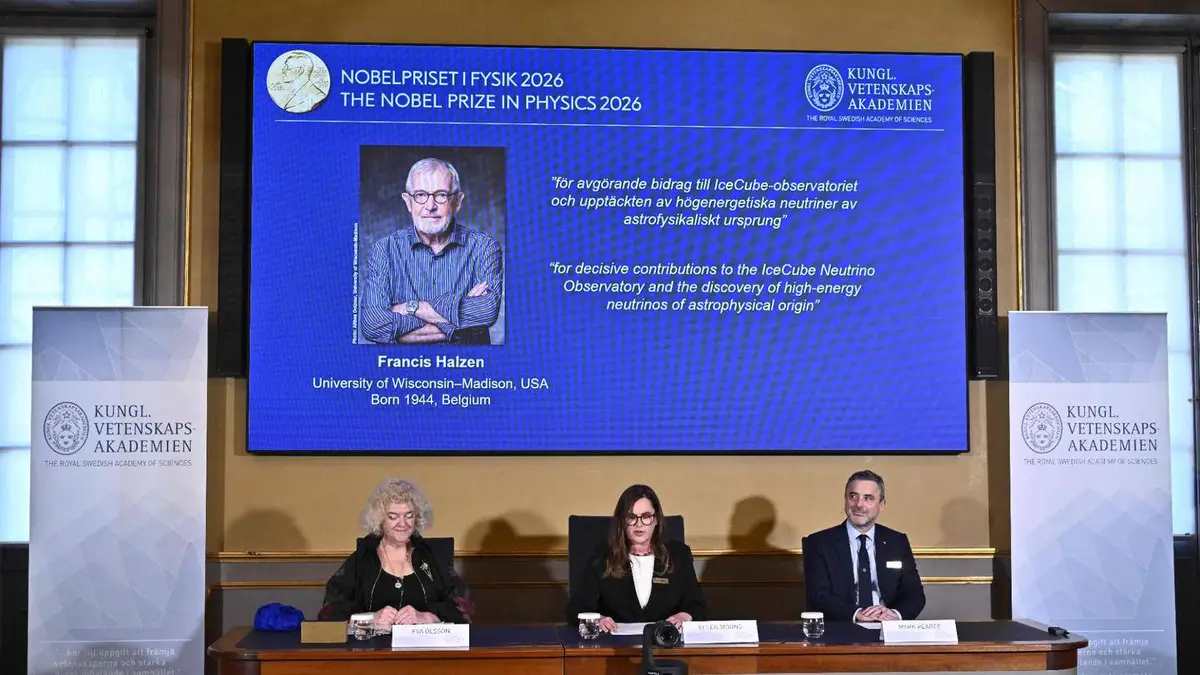
The 2026 Nobel Prize in Physics has gone to a detector rather than a lab bench: a cubic kilometer of ancient ice buried beneath the South Pole. Sweden’s Royal Swedish Academy of Sciences announced on October 6 that the award goes to Francis Halzen, an 82-year-old physicist born in Tienen, Belgium, for his decisive contribution to the IceCube Neutrino Observatory and the discovery of high-energy neutrinos of astrophysical origin.
Neutrinos are ghostly particles that stream through planets, people and almost everything else without stopping. That is exactly what makes them useful. Light from distant galaxies can be blocked by dust or bent by magnetic fields, but a neutrino carries a straight line back to whatever violent event created it. The hard part is catching one. IceCube does it by using the Antarctic ice sheet itself as a target: when a neutrino occasionally collides with a molecule of ice, it produces a faint flash of blue light, and a grid of optical sensors strung more than two kilometers deep records the pattern.
Halzen spent roughly four decades pushing the idea from an improbable proposal to a working observatory. He earned his doctorate at KU Leuven in 1969 and later built his career at the University of Wisconsin–Madison, where he helped assemble an international collaboration that now spans dozens of institutions. Drilling holes into the polar plateau and lowering detectors into them was an engineering problem as much as a physics one, and it took years of polar summers to complete.
The payoff came when IceCube traced a high-energy neutrino back to a known blazar, a galaxy with a supermassive black hole firing a jet almost directly at Earth. That single detection opened a new way of doing astronomy, one that reads the universe in particles rather than light. Researchers now use the observatory to study the most energetic accelerators in nature, from active galaxies to the aftermath of stellar explosions.
The prize also lands in a remarkable week for science. Days earlier, the Nobel in physiology or medicine went to Karl Deisseroth, Peter Hegemann and Georg Nagel for light-gated ion channels and optogenetics, the technique that lets researchers switch brain cells on and off with light. Together, the two awards celebrate instruments and methods as much as discoveries: tools that let scientists ask questions no one could previously test.
Elsewhere in this year’s physics news, a team at the University of Warwick reported the first known planet orbiting a white dwarf that appears to have formed from the dead star’s own ejected material, a second-generation world condensing from ashes about 270 light-years away. It is a reminder of how much of astronomy now depends on noticing faint, strange signals and then proving what they mean.
For China, the IceCube result carries a practical message. The country is expanding its own big-science infrastructure, from space-based observatories to deep underground and underwater experiments, and the Halzen story shows how long such bets can take to pay off. A detector that looked like a curiosity in the 1990s became the instrument that changed a field.
Halzen, now in his eighties, has spent much of his career explaining why a block of ice at the bottom of the world is worth the trouble. This week, the Nobel committee agreed with him.