A Rock Climber's Fall Exposes China's Bouldering Boom
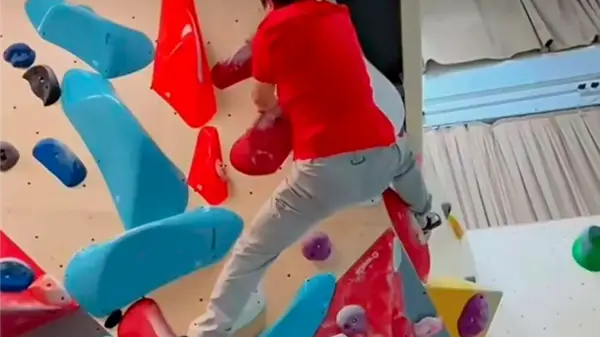
A well-known figure in Chinese technology is recovering from a serious climbing injury after a fall at an indoor bouldering wall. Zhou Hongyi, the founder of the cybersecurity company Qihoo 360 and one of China’s most visible tech personalities, said in a video posted on 11 October that he had fallen about three metres while bouldering the day before.
According to his account, he lost his grip on the wall and could not twist his body into a proper landing position. All the force of the fall landed on his left leg. He heard a distinct crack from his knee, and the leg stopped working immediately. Medical imaging later showed a shattered fracture in his left knee, damage to the shin bone and a smaller bone near the joint, a broken calf bone, fluid inside the joint and injury to the surrounding soft tissue. He said all business trips and public appearances would be cancelled for the next two to three months.
Bouldering is a form of climbing done without ropes on short walls, usually no more than four or five metres high. Instead of being caught by a harness, climbers rely on thick foam mats called crash pads and on a technique known as falling — learning to land on both feet with bent knees and a relaxed body, rather than reaching out with a hand or landing stiff-legged. Zhou’s description of a single leg taking the full impact is exactly the mistake that coaches warn against.
Indoor climbing has exploded in popularity across Chinese cities in recent years. Bouldering gyms, once confined to a handful of large coastal cities, now appear in shopping centres and converted warehouses from Chengdu to Shenzhen. The sport appeals to young office workers because it is social, requires little equipment and offers short, intense sessions that fit around a busy work schedule. National and regional competitions have grown alongside the gyms, and Chinese climbers have begun to make marks on the international circuit.
The boom has also brought growing pains. Many new climbers arrive without formal instruction, learning technique from short videos rather than from coaches. Gyms vary widely in how much they emphasise safety briefings, mat quality and supervision. Ankle and knee injuries are among the most common problems in the sport worldwide, and a poorly executed landing is usually the cause. Experienced climbers often point out that the hardest part of bouldering is not the climb itself but learning how to let go of the wall properly.
Zhou’s injury is a reminder that even fit, experienced adults can be caught out. His video, delivered calmly and with a touch of self-deprecating humour, has been widely shared. Some commenters joked that a tech founder finally found something harder than running a company. Others used the moment to ask their local gyms about coaching and safety standards.
For a sport still finding its footing in China, the episode carries a practical message. Falling well is a skill that can be taught, practised and repeated, and it deserves the same attention as strength or technique. As more Chinese cities fill with climbing walls, the gyms that invest in teaching people how to land safely may be the ones that keep their members coming back.