China's Go Rulebook Shrinks the Komi to 3.5 Stones
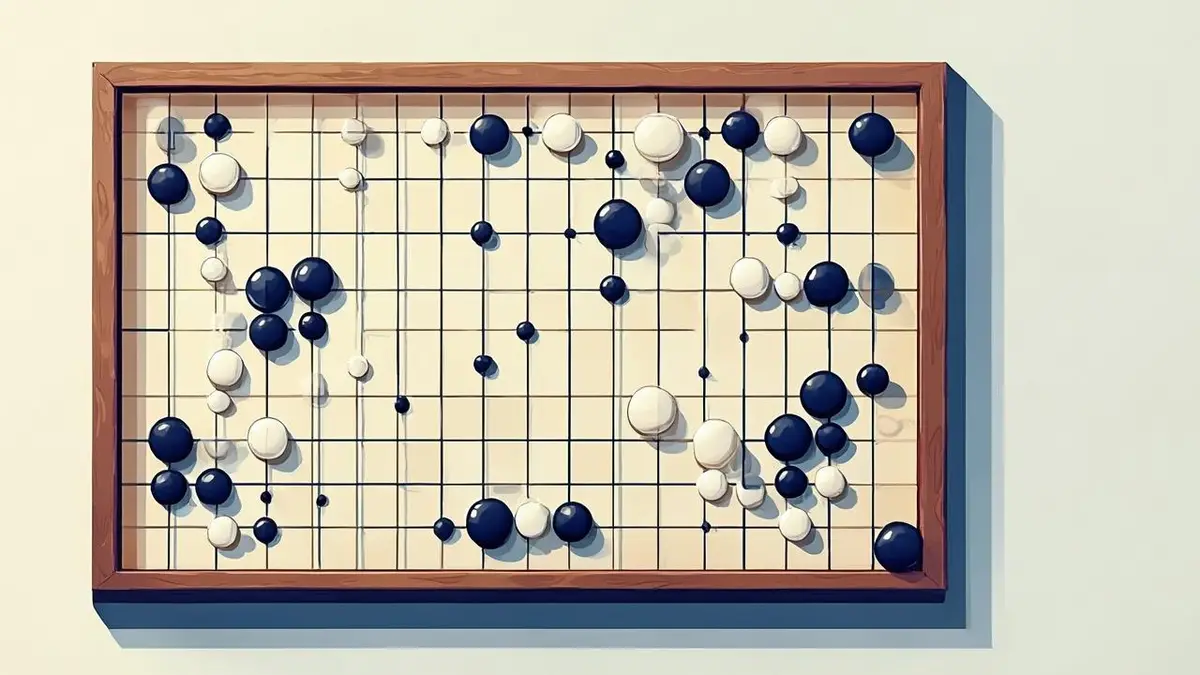
China’s Go Association has published a trial edition of its competition rules for 2027, and one line has done more arguing than the rest of the document combined: the komi, the compensation White receives for moving second, drops from 3.75 stones to 3.5. The change surfaced on Zhihu, a Chinese question-and-answer platform, where users spent a day pulling it apart.
For readers outside the game: Go is played on a grid, usually 19 by 19 lines, and a game is scored by counting the empty points each player surrounds plus the stones captured. Because Black moves first, White is given extra points at the end, called komi, to balance the advantage. In Chinese counting, a stone is worth two points, so 3.75 stones equals 7.5 points and 3.5 stones equals 7 points. The half-point at the end is the traditional guard against a draw.
That half-point is not decoration. Under the old 7.5-point komi, a game could not end in a tie; under 7 points, a draw becomes possible in principle. Whether the Chinese rules will simply award the win to White, replay the game, or accept a draw is the kind of detail players are now hunting for in the full text.
China is not the only rule-setter. Japan and Korea use 6.5 points, while some international events have experimented with 7.5. Each federation’s number reflects years of results and its own counting method, and a change by the Chinese body ripples through domestic leagues, youth tournaments and the international events where Chinese players compete.
The arithmetic is small, but the strategic effect is not. At 7 points, Black needs slightly less than before to stay ahead, which can encourage more aggressive opening play and make certain close endgames more attractive to the first player. Coaches will spend the winter recalibrating opening books and endgame drills.
On Zhihu, the argument split along familiar lines. Some users welcomed a return to a number they associate with older Chinese tournaments; others worried that a lower komi quietly tilts the game toward Black and will show up in win rates at the top level. A few asked the practical question: if a title match is tied after the change, what happens next?
The association’s trial label matters. A trial rulebook is a test, not a permanent settlement, and federations often adjust after a season of data. For amateur clubs, the practical effect may be modest — many local games are played with whatever komi the players agree on — but for professional players and tournament organizers, the number is the rule.
Go has a long history of arguments over balance, from the size of the board to the value of the first move. The 3.5-stone komi is the latest round in that argument, and the results will be counted one game at a time.