Why Chinese Ink Seals Stay Square, Not Round
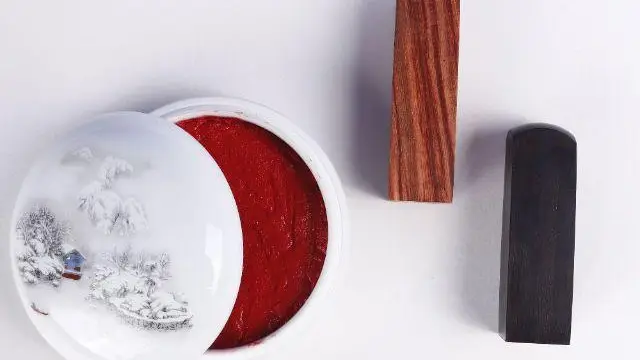
Anyone who has handled a Chinese document knows the look: a round red stamp pressed on an official paper, and beside it, often, a small square seal in vermilion ink, used by artists, collectors and scholars. A reader on the Chinese Q&A platform Zhihu recently asked why the old square seals were never replaced by the round shape that dominates modern administration. The discussion that followed is a small window into how Chinese design thinks about order, orientation and the human hand.
The most common theory — that square stamps are easier to press crookedly — does not survive much scrutiny. Take a round official seal: which direction is “up”? Without a mark, it is nearly impossible to tell at a glance whether it has been rotated. A square seal, by contrast, has four corners and four edges; the eye instantly registers a tilt. In fact, one of the rare Chinese regimes that used round seals, the short-lived Xu-Song state, carved them as a square inside a circle, so the printed impression still carried a clear axis. Even the engraved text on the back of an official seal — the record of its name, issuing office and date — was aligned to that same orientation.
Square seals are also older. Early Chinese seals were cast or carved as small squares of bronze, jade, bone or stone, worn on cords or set into boxes of ink paste. The square form matched the grid of Chinese characters, which are built to sit in imaginary boxes of equal size. A name carved in two or four characters fits a square almost perfectly, so the seal became a compact, legible signature — a personal mark that could be recognised at a glance on a painting, a letter or a contract.
That practical fit became a cultural one. In traditional Chinese thought, the square stood for the earth, for stability and for correct measure; the circle stood for heaven and motion. A personal seal was meant to sit quietly and firmly on a page, not to spin. When a painter added a square seal beneath a landscape, the red block acted as a visual full stop, balancing the sweep of ink. Collectors added their own seals over centuries, so a single scroll can carry a chain of small red squares recording who owned it and when.
The round seal arrived with modern bureaucracy, where standardisation and machine-made stamps mattered more than the hand of an individual. Circles are easier to mass-produce and harder to counterfeit in a standard size, and they read clearly when pressed quickly. Yet the square seal never disappeared. Walk through the old book markets of Beijing or the art streets of Hangzhou and you will find craftsmen carving names into soft stone, testing each cut on paper until the character sits exactly in its corner. Tourists buy them as souvenirs; calligraphers and painters still use them as signatures.
In that sense the question answers itself. The square seal was not kept because it was easy, but because it was expressive. It turned a name into a small, deliberate object — a mark that says not only who you are, but that you chose to press it there. Round stamps manage people. Square seals belong to them.