Zhou Hongyi's Share Transfer Isn't a Sell-Off, But 360's Slide Is Real
Zhou Hongyi, the founder and public face of Chinese cybersecurity and AI company 360 Security Technology, has moved part of his holding structure — a transaction that headline scanners quickly turned into talk of a sell-down. The distinction matters: transferring equity between entities Zhou controls is not the same as selling shares into the market. But in a stock that is already bruised, the difference is easy to lose.
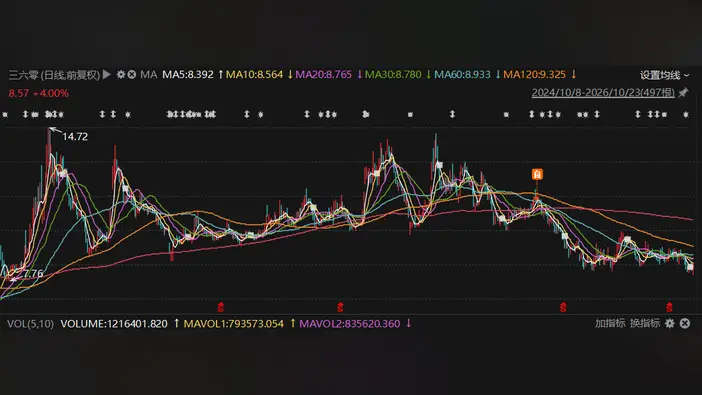
360 trades in Shanghai under the ticker 601360. On October 23 its shares touched 8.04 yuan intraday, a fresh low for the current stretch and only a few tenths above the 7.76 yuan trough reached in early October 2024. For a company that once pitched itself as China’s answer to the big global security firms and has since repositioned around AI, that is an uncomfortable place to sit.
The trigger for this week’s chatter was a pair of disclosures. One, dated October 15, concerned the controlling shareholder, Qixin Zhiyuan, and set out changes in the holding chain. A second followed. Read quickly — or read by an algorithm that surfaces the word for reduction — the pair looked like insiders heading for the exit. Read properly, the picture is more about how Zhou arranges the vehicles that hold his stake than about cashing out.
Why does the market care so much about structure? Because in Chinese listed companies, the controlling shareholder’s arrangements function as a confidence signal. When the share price is near historic lows, any filing that mentions the top of the ownership tree gets amplified. Retail investors, who make up a large share of trading in A-shares, tend to react to the headline first and the footnote second.
360’s underlying story is a familiar one in China’s tech sector: a profitable legacy business, in this case security software and related services, funding a costly push into a newer field. Here the newer field is artificial intelligence, where 360 has launched large language models and consumer-facing assistants. Those products generate attention and, so far, modest revenue next to the cost of computing power and talent.
That gap is what the share price is arguing about. A company promising an AI future while its legacy franchise matures gets valued on belief, and belief is fragile when the chart is making lower lows. A founder reshuffling his holding companies does not change the cash flow, but it does invite the question of why the structure needed adjusting now.
The broader context is a Chinese market that has spent 2026 rewarding some technology names and punishing others. Investors have grown choosier about which AI narratives they will pay for, and companies with heavy legacy businesses have had to prove the new line can carry its own weight. 360 sits squarely in that debate.
What to watch is not the next filing but the next earnings report: whether AI-related revenue starts to show up as a line item large enough to matter, and whether the security business can keep funding the transition. Until then, expect every ownership disclosure to be read as a verdict on the company rather than a note on paperwork.