A Human Challenger Stepped Into a Robot's Cage and Got Kicked
For the past two years, the public conversation about humanoid robots has revolved around factories and housework: can they tighten bolts on an assembly line, fold laundry, or unload a dishwasher? A recent clip from a robot combat event in the United States suggests a third career path is quietly opening up — professional fighting.
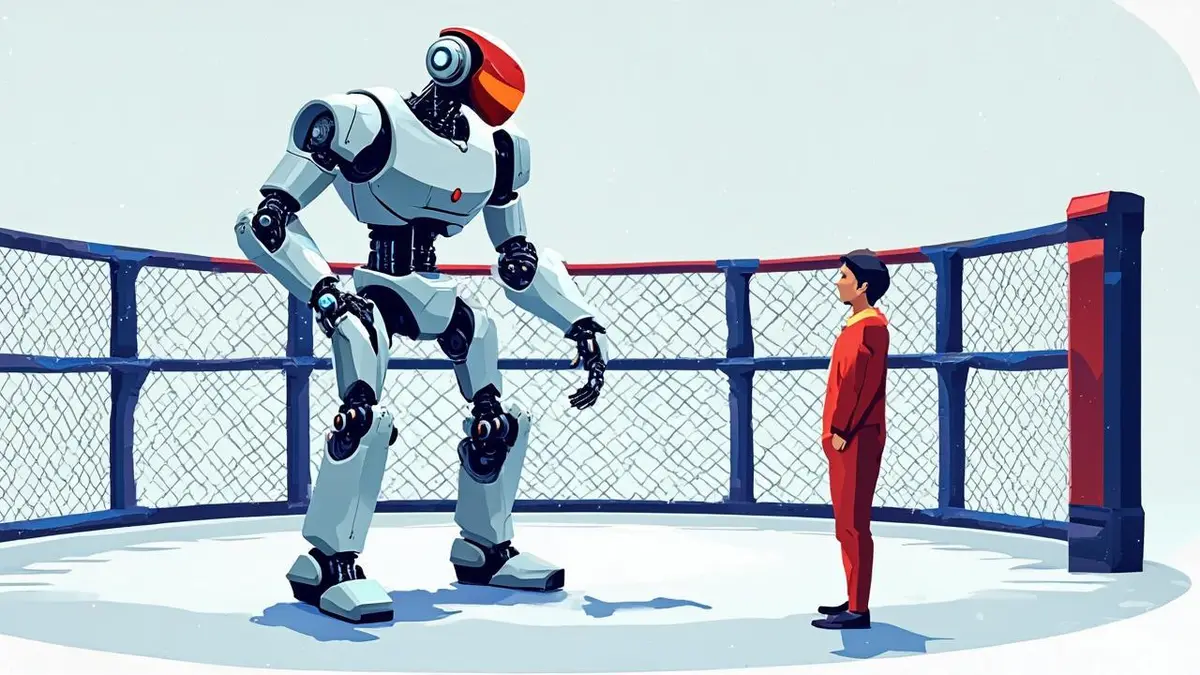
At the event, a modified EngineAI T800, a full-size bipedal humanoid built by the Chinese robotics company EngineAI, stepped into a caged ring to face a human challenger. The man came prepared, wearing protective gear and padding, and walked in swinging. For a few seconds it looked like a fair fight. Then the machine planted one leg and kicked. The challenger left the ground and landed flat on his back, and the crowd lost its collective mind.
The moment spread quickly on Chinese social media, where it was framed half-jokingly as the opening scene of a certain science-fiction film franchise. The humor hides a real technical point. A kick like that demands fast balance recovery, precise force control and a stiff enough frame to absorb the recoil. Falling over is the default state for a biped; staying upright while delivering a strike is much harder than walking across a showroom floor.
EngineAI is one of a wave of Chinese humanoid startups competing with better-known names in the United States. Its T800 is a heavy, high-torque platform designed for dynamic movement rather than gentle service tasks. Robot combat, it turns out, is an unusually honest benchmark: the machine either stays on its feet or it doesn’t, and everyone can see the result in real time.
That is partly why these events keep drawing crowds. Humanoid makers have spent years promising warehouses, eldercare and household chores, but mass deployment remains years away. A cage match is cheaper than a factory pilot, easier to film, and produces a clip that travels worldwide in hours. It also stress-tests hardware in ways a demo video never can, because the opponent is actively trying to knock the robot down.
There is an obvious safety dimension. A machine weighing tens of kilograms, moving under its own power, can injure a person even without intending to. Promoters typically require helmets, padding and an emergency stop, and the human volunteers usually know exactly what they are signing up for. Still, the sight of a robot kicking a man across a ring raises questions that engineers would rather answer before regulators ask them.
The deeper story is about direction. Chinese robotics firms are pushing aggressively on hardware, supply chains and cost, and the country now hosts a dense cluster of component makers for motors, reducers and sensors. Fighting is a spectacle, but the underlying capabilities, balance, force control, rapid perception, are exactly what a useful working robot needs. If a machine can take a kick and stay standing, it can probably survive a messy warehouse floor.
Whether robot-versus-human combat becomes a durable sport or a short-lived viral genre is an open question. What seems clear is that the public now has an intuitive way to judge progress. Instead of reading spec sheets about degrees of freedom, viewers watch a challenger get launched into the air. Crude, but memorable — and for the companies involved, that may be worth more than another trade-show booth.