Chinese Doctors Are Fighting Back Against Patients Who Arrive With an AI Diagnosis
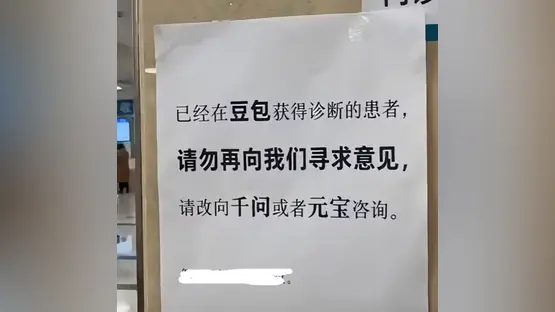
A fake sign, pasted on social media, tells patients who have already received a diagnosis from Doubao to stop asking doctors for a second opinion and to try Qwen or Yuanbao instead. The image is a joke. The frustration behind it is not. Doctors across China have spent the past months complaining that patients now arrive at clinics clutching an AI-generated answer, ready to argue with the person who spent years in medical school.
The tools in question are mainstream consumer products. Doubao is the chatbot made by ByteDance, the company behind TikTok’s Chinese sibling Douyin. Qwen comes from Alibaba, and Yuanbao from Tencent. All three are free, fast, and happy to answer a question like what is causing this stomach pain. That ease is exactly the problem: a large language model produces a confident paragraph whether or not it has enough information, and a patient reading it has no easy way to tell the difference.
Doctors describe a familiar pattern. A patient arrives with a list of possible conditions and a preferred treatment. The physician disagrees, and the consultation turns into a debate about whose source is right. Some clinicians say the worst cases involve people who delayed a visit because an AI told them the symptoms were minor. Others describe the opposite: patients who arrive frightened by a rare disease the model mentioned as a remote possibility.
The anger is real enough that it has become its own genre of online humour. The fake clinic notice is one example. Doctors posting late-night rants about night shifts spent arguing with a phone screen are another. The joke works because almost everyone recognises the scene, on one side of the desk or the other.
The more useful question is what AI is actually good for in this setting. Researchers and clinicians who study the technology tend to agree on a rough division of labour. A chatbot can explain what a test measures, translate a discharge summary into plain language, remind someone to take medication, or help a patient prepare questions before an appointment. It is much weaker at diagnosis, which depends on physical examination, history and context that a text prompt rarely captures.
That distinction matters more in China than in many markets, because the tools are already in hundreds of millions of pockets. There is no appointment needed to ask Doubao a question, and no gatekeeper checking whether the answer is sensible. The result is a vast, uncontrolled experiment in self-triage, running alongside a hospital system where doctors see dozens of patients a day and have little time to unpick a chatbot’s reasoning.
Some hospitals have started to respond, not by banning the tools but by acknowledging them. A few clinics now ask patients to bring any AI advice they have received, so the doctor can address it directly rather than discover it mid-consultation. The approach treats the model as a source of questions rather than answers.
The fake sign, in the end, points at something real. Patients are not going to stop asking AI about their symptoms, and doctors are not going to stop being annoyed when the answer is wrong. The question is whether the consultation can adapt fast enough to make the chatbot a bridge instead of a battleground.