ChatGPT Cracks a 26-Year-Old Math Guess, and 1,008 Mathematicians Push Back
A mathematical conjecture that had stood for 26 years has reportedly been solved by ChatGPT, and the reaction from the people who spend their lives doing mathematics has been unusually sharp. According to Chinese tech outlet 36Kr, the result landed in the middle of a broader dispute about whether large language models are now genuinely doing research mathematics, or producing plausible-looking text that happens to pass a check.
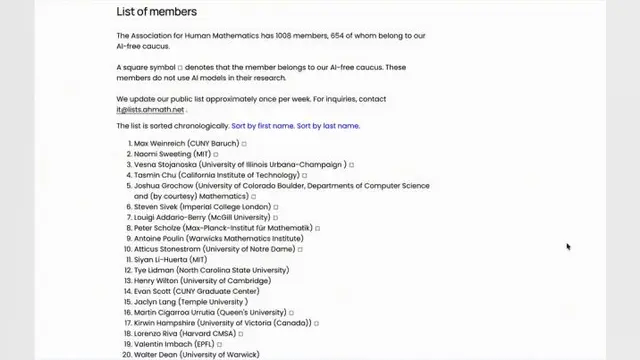
The immediate consequence was organisational. A group of mathematicians founded an association they call the Human Mathematics Association, or AHM, and by the time the news circulated it had gathered 1,008 signatories from mathematics departments at leading universities around the world. The pledge attached to membership is blunt: members say they will not contribute work to commercial AI companies, and will not publish any mathematics paper written by an AI.
The scale of the signature list is what makes the episode notable. Mathematics has long been treated as the discipline least vulnerable to automation, because its output is supposed to be a proof that other experts can check line by line. A language model that can generate a convincing proof draft changes the economics of that checking, and the signatories appear to be responding less to one solved problem than to the prospect of a flood of machine-written submissions.
The dispute also has a generational edge. The report notes that a substantial share of the signatories are established researchers, and that the argument inside departments has split colleagues who see AI as a useful assistant for exploration from those who see it as a threat to the credit system that sustains academic careers. Neither side disputes that the tool is improving quickly; they disagree about what should follow from that.
For global readers, the useful context is that this is not a fringe protest. China has been building out AI research capacity at speed, and Chinese mathematicians publish heavily in the same international journals as everyone else, so a norm against AI-authored papers adopted by a large international group would be felt in hiring, peer review and journal policy well beyond any single country.
The practical question is enforcement. A pledge is easy to sign and hard to police, particularly when a model can be used to draft, check or rewrite a proof in ways that leave no obvious trace. Journals have not announced a common standard for disclosure, and universities have not said how they would treat a paper that was partly AI-assisted.
What the episode does show is that the argument over AI in science has moved from hypotheticals to institutions. A thousand researchers organising around a single tool is a different kind of signal from a survey or an op-ed, and it puts pressure on the companies building these systems to explain how their models reached a result, not just that they did.
Watch what happens to the claim itself. If the 26-year-old conjecture holds up under independent review, the case for AI as a research instrument gets much stronger; if it does not, the AHM’s founding argument will look considerably more prescient.