The Loneliness of Seeing: What Happens When the Blind Regain Sight
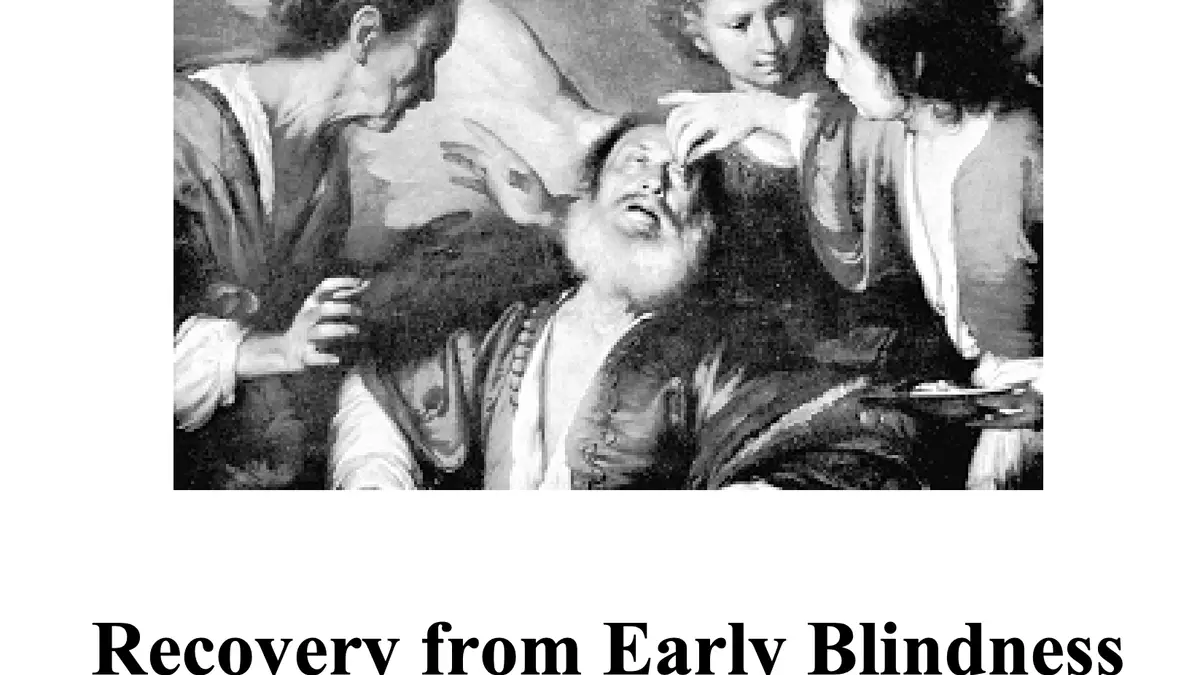
Imagine living your whole life in darkness, then one day a surgeon gives you sight. The obvious script is tears of joy, a new beginning. But one of the most cited cases in the psychology of vision suggests something far stranger — and far sadder.
The story comes from British psychologist Richard Gregory, who documented a man known as B. Blind from birth, B received a corneal transplant at the age of 58 in 1958. He could suddenly see. Yet over the following months he began closing his eyes more and more often. At night he refused to turn on the lights. He preferred to retreat into the darkness that had been his home for nearly six decades.
What B described was not ingratitude but disorientation. Sight, for someone who has never had it, is not a gift that arrives with an instruction manual. A face, a tree, a staircase — these are not instantly recognizable objects. They are mosaics of light, shadow and color that the brain must learn to assemble into meaning. A person blind from birth has spent decades building a rich mental world out of touch, sound, smell and memory. Sight does not replace that world. It collides with it.
This is where the broader questions start. Philosophers and neuroscientists have long debated what perception really is. The popular assumption is that eyes work like cameras: light comes in, an image forms, and we simply see what is there. Cases like B’s suggest the opposite. Seeing is an act of interpretation, and interpretation is learned. Without years of practice connecting what the eyes register to what the hands already know, vision can be overwhelming rather than liberating.
B’s decline was severe enough that he died in depression roughly two years after the operation. Gregory’s account has been revisited, questioned and refined by later researchers, and modern surgical teams now prepare patients far more carefully. The case is not treated as proof that restoring sight is a mistake. It is treated as a warning that the brain and the self are not as separable as we like to think.
For anyone with intact vision, the case is a quiet mirror. We assume our senses deliver the world to us directly and objectively. But every perception is filtered through experience, expectation and language. Two people can look at the same street and genuinely see different things. The man who regained his sight did not simply gain a new sense. He was asked to become a different person, late in life, without being able to practise in advance.
That is why the story keeps resurfacing in discussions of identity, adaptation and what it means to know something. It also carries a gentler lesson for ordinary life. When someone struggles to adjust to a change we consider obviously good — a move, a promotion, a recovery — the difficulty may not be stubbornness or ingratitude. It may be that the new world has not yet been translated into the language their mind already speaks.
In the end, B’s story is less about eyes than about the self. Vision is not just information arriving. It is a skill, a relationship, and in some ways a lifelong conversation between what is out there and who we have learned to be. The man who chose darkness was not rejecting the light. He was holding on to the only world he knew how to live in.