One Spoonful of Soil Holds 10 Meters of Fungal Thread
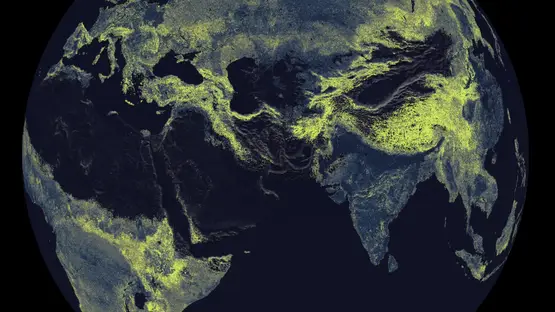
Pick up a single teaspoon of healthy soil and you are holding something almost impossible to picture: roughly ten meters of living fungal thread. Now multiply that across every patch of land on Earth, and you get the first global accounting of one of the planet’s least visible — and most important — structures.
The numbers come from a study published in the journal Science in June 2026. A research team set out to estimate, at worldwide scale, the total size of the networks built by arbuscular mycorrhizal fungi, a group known as AMF. These fungi are not free-living loners. They strike a partnership with the roots of most land plants, threading their fine filaments, called hyphae, into root tissue and reaching far out into the surrounding soil.
That partnership is a trade. The fungus gathers water and minerals — above all phosphorus — from places a root could never reach on its own, and hands them to the plant. In return, the plant supplies sugars made through photosynthesis. It is one of the oldest and most widespread deals in biology, and it quietly underpins much of the food we eat.
According to the team’s calculations, the total length of living hyphae in the world’s surface soils is about 11 billion billion kilometers. The figure is not a typo. To put it another way, if you laid that thread end to end, it would stretch about 74 million times the average distance from the Earth to the Sun. The carbon locked inside these filaments comes to roughly 300 million tonnes, a reservoir that rarely appears in climate accounting.
Why does the size matter? Because a network this vast moves material. Fungal hyphae act as living pipelines, shuttling nutrients between plants and storing carbon in soil. When land is plowed, paved over, or stripped of its vegetation, those threads are cut. The study gives researchers a baseline — a starting number — against which future gains or losses can be measured.
The work also reframes how we think about soil itself. To most people it is dirt, a brown background to the green world above. In reality it is a dense, branching infrastructure, built by organisms we almost never see and only partly understand. A single gram can contain kilometers of hyphae, alongside bacteria, insects, and spores in numbers that defy intuition.
Scientists caution that global estimates of this kind carry wide uncertainty. Sampling every soil on Earth is impossible, so the authors combined field measurements with models of plant cover and soil conditions. The exact total will be refined. What is unlikely to change is the conclusion that these fungi form one of the largest biological structures on the planet — larger than any forest canopy, any coral reef, any single organism.
For farmers and gardeners, the practical lesson is simple. Practices that keep soil covered, minimize deep disturbance, and maintain living roots tend to protect the fungal partners already present. For everyone else, the finding offers a fresh way to see the ground underfoot: not inert ground, but a hidden web, patient and enormous, doing quiet work on a scale that took until now to even estimate.