Baidu Says Its Own AI System Helped Build Its Next Model
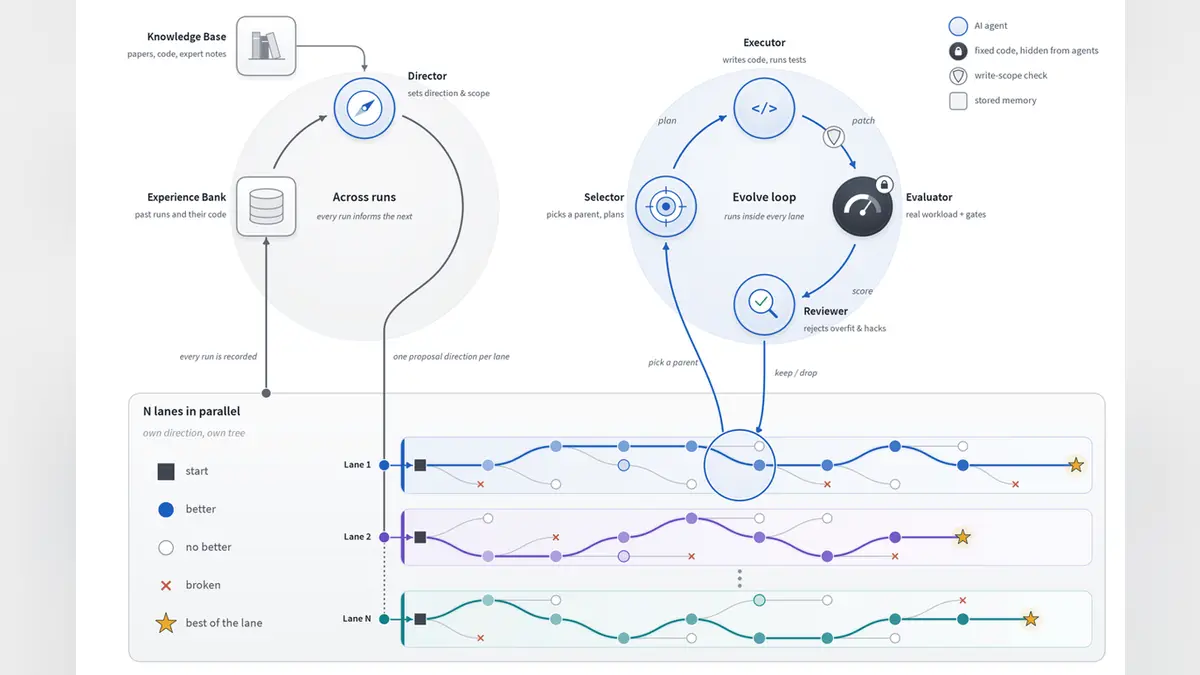
Baidu has given the clearest look yet at how far it is pushing automation into its own model development. On November 9, its ERNIE team disclosed progress on what the industry calls RSI — recursive self-improvement — and named the system doing the work: ERNIE Evolve, an automated research tool that took part in developing the upcoming ERNIE 5.5 Flash model.
According to the company, ERNIE Evolve is designed to work from a goal and a set of constraints rather than a fixed script. It proposes research directions on its own, runs experiments, checks the results and banks what it learns. Baidu says the system can keep refining an existing line of work, but also branch into new directions when the evidence points that way — the difference between tuning a known recipe and deciding which recipe to try next.
The disclosure is a first for Baidu, which has generally described its models in terms of benchmark scores and release dates rather than the process behind them. Framing ERNIE Evolve as a participant in real model development, rather than a lab demo, is a signal that the company wants to be seen in the same conversation as labs abroad that have talked openly about AI assisting AI research.
The phrase self-improvement invites skepticism, and reasonably so. Systems that propose and test their own ideas still depend on human-set objectives, compute budgets and judgment about which results count as progress. What Baidu appears to be describing is a faster loop for the trial-and-error that already consumes much of a model team’s time, not a system that sets its own agenda unsupervised.
Baidu’s broader position gives the claim weight and adds pressure. The company was among China’s earliest large-model builders, but it has spent the past year fighting for attention against rivals with stronger consumer apps and deeper pockets. Its search business remains the main distribution channel, and management has been steadily repositioning the company around AI infrastructure and models rather than advertising alone.
The timing also matters. ERNIE 5.5 Flash is described as an upcoming release, and Baidu has already opened the base of an earlier ERNIE 5.5 Flash model — a 280-billion-parameter system — to outside developers. A Flash line is typically built for speed and cost rather than raw capability, which makes it a sensible place to test whether automated research can deliver efficiency gains that show up on a bill.
For global readers, the takeaway is less about one model than about method. If automated research systems genuinely shorten the gap between an idea and a working experiment, the labs that adopt them first could iterate faster than rivals with bigger clusters. That is the competitive logic behind Baidu’s disclosure, and it is the claim worth testing.
What to watch is concrete: whether ERNIE 5.5 Flash arrives on the timeline the company has hinted at, and whether Baidu publishes any evidence that ERNIE Evolve’s contributions carried into the shipped model. Until then, the announcement is a promise about process — the part of AI development that is hardest to verify from the outside.