Baidu Opens Its 280-Billion-Parameter ERNIE 5.5 Flash Base to the World
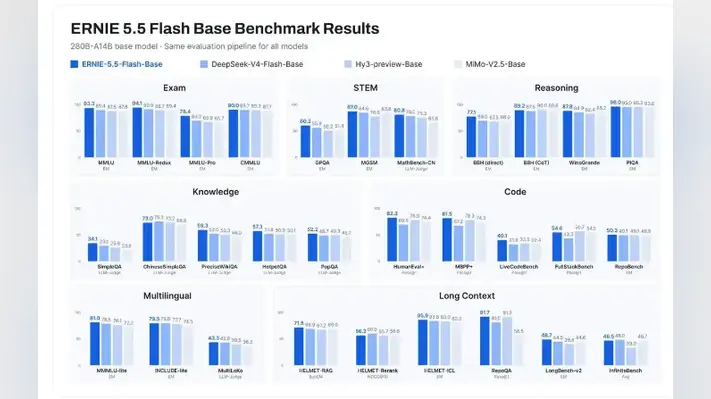
Baidu released the weights of its newest foundation model, ERNIE 5.5 Flash Base, on November 5, making one of China’s largest open models available for anyone to download, fine-tune and deploy. The company says it is the base version of its ERNIE line, the family of large language models that powers Baidu’s search engine and its Ernie chatbot.
The headline number is scale: 280 billion parameters in total. But the model uses a mixture-of-experts architecture, a design in which each token of text activates only a fraction of the network. Here that fraction is about 14 billion parameters, which keeps the cost of running the model far below what the raw size suggests. The model was pretrained on 33.5 trillion tokens, with a pretraining context window of up to 128,000 tokens; during fine-tuning and inference it can handle contexts of up to one million tokens, enough for very long documents or codebases.
Baidu says the model set a new state of the art among models of comparable size across benchmarks covering knowledge, reasoning, mathematics, coding, multilingual ability and long-context handling. It names DeepSeek-V4-Flash-Base and Hy3-preview-Base as the models it surpasses. Such self-reported comparisons deserve caution, since benchmark scores depend heavily on how tests are run, but they are the currency of the open-weight market.
The move fits a broader pattern in Chinese AI. Over the past year, the country’s biggest labs have increasingly released model weights rather than keeping them closed, using free downloads to win developers, gather feedback and build ecosystems around their tools. Open weights let startups, researchers and hobbyists run capable models on their own hardware, which matters in a market where API prices have fallen sharply and where access to foreign models can be uncertain.
For Baidu, the calculation is strategic. The company was an early Chinese champion of large language models but has faced stiff competition from younger rivals, including DeepSeek and a wave of startups, as well as from bigger platform players. Publishing a strong base model gives Baidu visibility with the developers who build applications on top of models, and a chance to seed its tooling and cloud services.
The Flash label signals the target: speed and cost rather than maximum capability. Base models are raw material, not finished products; they generally need fine-tuning or alignment before they behave well in consumer applications. Releasing the base version invites the open-source community to do that work, a common route to rapid adoption.
What happens next will be measured less in benchmark tables than in downloads and derivatives. Expect fine-tuned variants, quantized versions that run on smaller machines, and comparisons against DeepSeek’s open releases within weeks. For global developers, the practical question is whether a 280-billion-parameter model with a lean activation budget can deliver competitive quality at a price that makes sense outside China’s domestic cloud market.