Zero-Knowledge Proofs Move From Crypto Niche to Everyday Computing
When a cloud server tells you it ran your code correctly, how do you know it did not cut corners? A branch of cryptography called zero-knowledge proofs offers an answer: the server can produce a short mathematical certificate proving the result is correct, without revealing the underlying data or forcing you to rerun the whole job. Until recently these proofs were slow and awkward to write, mostly confined to cryptocurrency and academic demos.
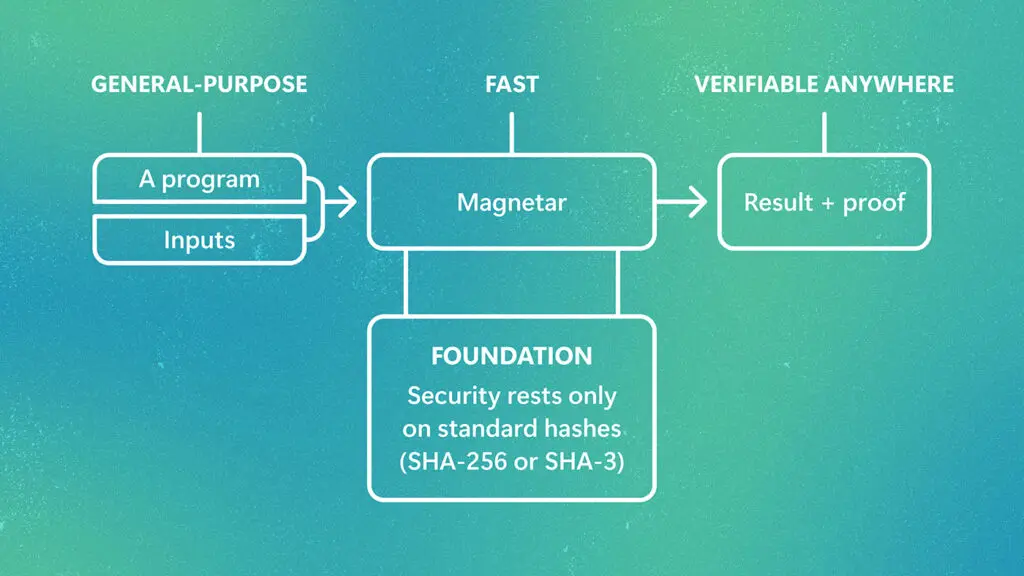
A team at Microsoft Research is trying to change that with a project called Magnetar. According to a recent post from the lab, the system is designed to bring zero-knowledge proofs into the mainstream by supporting standard programming languages, so developers do not need to learn a bespoke proof language or rewrite their code from scratch. The team reports major speed gains alongside that usability work.
The appeal is broad. In cloud computing, a customer could verify that a remote server processed sensitive records according to an agreed rule without handing over the data itself — useful for healthcare, finance and any setting where privacy rules bite. In artificial intelligence, proofs could certify that a model produced an output from a particular input, offering a new kind of audit trail in an era of opaque models.
Zero-knowledge proofs work by turning a computation into a mathematical statement that can be checked quickly. The hard part has always been the overhead: proving a large program can take many times longer than simply running it. Magnetar’s contribution appears to be a mix of compiler techniques and arithmetic tricks that shrink that gap while keeping ordinary languages usable.
That combination matters because adoption is usually blocked less by theory than by friction. If a developer must become a cryptography expert to add verifiable computation, most will not bother. Support for familiar languages lowers the barrier, and speed improvements make the approach affordable at the scale of cloud services and data pipelines.
The research also speaks to a wider shift in computing. As more work moves to remote servers and as AI systems make decisions that affect real people, trust is increasingly something that must be demonstrated rather than assumed. Verifiable computation gives engineers a tool to back claims with proofs instead of promises, whether the claim concerns a database query, a financial calculation or a model’s output.
Challenges remain. Proof systems are complex, and getting the security details right is unforgiving; bugs can quietly undermine guarantees. Costs, while falling, are still significant for very large workloads. And standards are immature, meaning early adopters may face churn as techniques evolve.
Still, the direction is clear. Work like Magnetar suggests that zero-knowledge proofs are graduating from a niche cryptographic curiosity into a practical building block for cloud and AI systems. For companies that handle sensitive data or must show their work, the ability to verify a result without rerunning it or exposing secrets could soon become a standard expectation rather than a luxury.