New AI System Designs Proteins Atom by Atom, and They Work
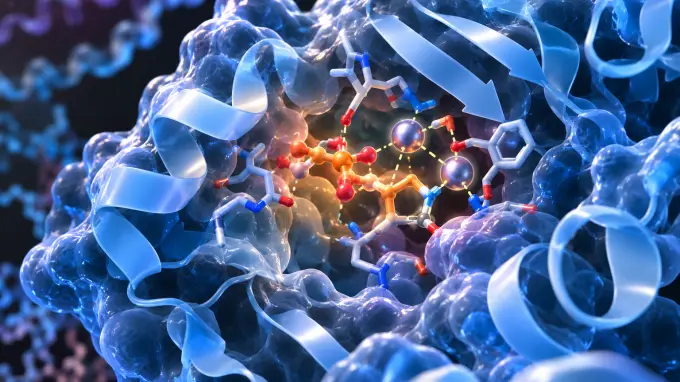
A generative artificial intelligence system that designs proteins and nucleic acids atom by atom has now had its full blueprint published, and proteins it invented from scratch have carried out the intended chemistry in real laboratory reactions.
The system, called RFdiffusion3 or RFD3, was built by an international team drawing on the University of Washington in the United States, the University of Oxford in Britain and the chip company Nvidia, among others. The details appeared in the journal Science, with reports circulating in the Chinese tech press on October 19. The team includes David Baker, the University of Washington professor who shared the 2024 Nobel Prize in Chemistry for work on computational protein design.
The advance is about resolution. Earlier protein-design tools worked with larger building blocks, arranging chunks of protein structure the way a designer might move furniture around a room. RFD3 instead models individual atoms, letting it place every bond and side chain with far finer control. According to the reports, it can generate protein structures roughly an order of magnitude faster than the previous generation of the system.
That speed and precision matter because proteins are the molecular machines that do most of the work inside living cells. If researchers can invent new ones on demand, they can aim at problems natural proteins never evolved to solve: new catalysts for industrial chemistry, sensors, materials, and potential medicines.
The most striking claim is that this is not only a computer exercise. Proteins freshly designed by RFD3 were synthesized and tested, and they performed the functions the designers intended in actual chemical reactions. That step, from a predicted structure on a screen to a working molecule in a test tube, is where most computational design efforts historically stumble.
The system also extends beyond proteins to nucleic acids such as DNA and RNA, widening the range of molecular tools scientists can attempt to build. The team published its detailed design scheme so that other groups can examine and build on the method, a practice that has become common in the fast-moving field of AI-driven biology.
The work fits a broader shift in the life sciences, where machine learning is moving from analyzing data to proposing entirely new molecules. Protein design has become one of the clearest demonstrations that generative models can produce objects that do not exist in nature and that still behave as intended under real-world conditions.
For global readers, the significance is less about any single molecule than about the tool itself. A system that can sketch a protein at the atomic level, and have that sketch hold up in the lab, shortens the path from idea to experiment. The next test will be whether labs around the world can use it to design proteins that solve practical problems in medicine and industry, rather than only elegant demonstrations.