Nobel Chemistry 2026: The Mirror Molecules That Learned to Copy Themselves
Chirality is the chemistry of handedness. A molecule is chiral when it exists in two forms that are mirror images of each other, like a left hand and a right hand. All the amino acids that build proteins on Earth come in two such mirrored versions, yet living cells use only one of them. The other is vanishingly rare in nature. For decades, chemists could not explain how this one-sided preference, known as homochirality, ever got started.
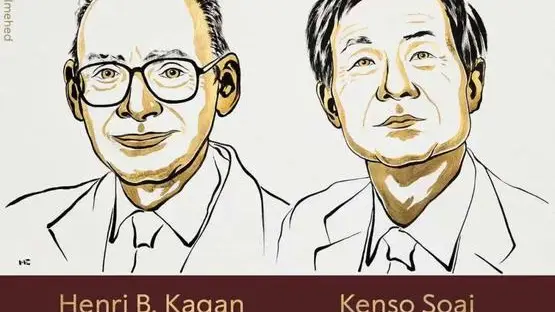
The 2026 Nobel Prize in Chemistry, announced this week, honors two scientists whose experiments helped answer that question. Henri Kagan, a French chemist, and Kenso Soai, a Japanese chemist, share the award for discovering nonlinear effects and autocatalysis in asymmetric organic synthesis. In plain terms, they showed that a reaction which makes both mirror forms of a molecule need not end in a 50-50 tie. Under the right conditions, a tiny imbalance can amplify itself until one hand dominates.
Kagan’s contribution came from a surprising place. While studying catalysts that nudge reactions toward one mirror form, he found that the relationship between catalyst purity and product purity was not a straight line. A catalyst that was only slightly biased could produce a product with a much stronger bias. This nonlinear effect meant that small random imbalances in a prebiotic soup could snowball, rather than being averaged away.
Soai pushed the idea further with a reaction that now bears his name. In the Soai reaction, the product of the reaction acts as a catalyst for its own formation, a phenomenon called autocatalysis. Starting from a nearly even mixture, the system spontaneously tips toward one mirror form and keeps accelerating. It is, in effect, a chemical version of a copying machine that prefers whatever it made last.
Together, the two discoveries sketch a plausible route from random chemistry to the uniform handedness of life. They also matter far beyond origin-of-life research. Chiral catalysts are workhorses of the pharmaceutical industry, where the two mirror forms of a drug can behave very differently in the body. One may be a medicine, the other inert or harmful. Understanding how to steer reactions toward a single hand, and how to amplify small advantages, helps chemists make safer and more efficient drugs.
Soai’s path to Stockholm was steady rather than sudden. He settled on chemistry in his second year of university, earned a doctorate at the University of Tokyo, then did postdoctoral work in the United States before building his own laboratory. Kagan, for his part, originally wanted to be an engineer, and a deferral redirected his life toward chemistry. He came close to a Nobel roughly a quarter of a century ago, making this year’s recognition a long-delayed honor at age 95.
The prize also fits a pattern in this year’s awards, which have celebrated tools that turn the invisible into the visible, from light-controlled brain cells to ghostly particles caught beneath Antarctic ice. The chemistry award adds a quieter achievement: showing how a world of identical mirror images could have emerged from a world that had no preference at all. For chemists, that is less a curiosity than a founding principle, and one that continues to shape how medicines are designed today.