China's 'Artificial Sun' Project Hits a Manufacturing Milestone
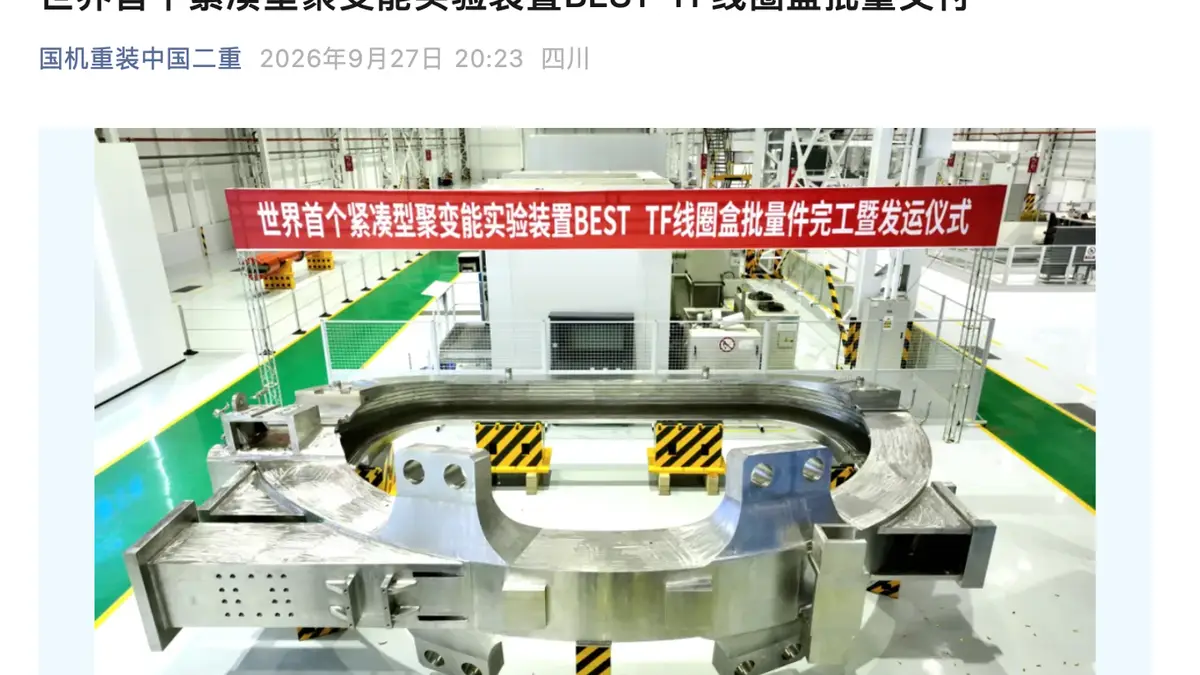
On September 27, a ceremony in Deyang, Sichuan Province, marked a quiet but significant moment in the global race to harness fusion energy. The state-owned equipment maker China National Machinery Industry Corporation, known as Sinomach, announced the completion and shipment of the first batch of toroidal field coil housings for a device called BEST — the Burning Plasma Experimental Superconducting Tokamak. It is the world’s first compact fusion energy experiment designed to bridge the gap between experimental reactors and future demonstration power plants.
Fusion, the reaction that powers the sun, has long been pursued as the ultimate energy source. It promises abundant fuel from seawater and virtually no long-lived radioactive waste. The challenge is containing plasma hotter than the sun’s core. Tokamaks use powerful magnetic fields to suspend that plasma in a doughnut-shaped chamber. The toroidal field coils are the backbone of that magnetic cage, and their housings must endure extreme cold, intense magnetic forces, and enormous mechanical stress for years.
BEST is being built in Hefei, Anhui Province, by the Institute of Plasma Physics under the Chinese Academy of Sciences. Unlike giant international projects such as ITER in France, BEST is deliberately compact. Its goal is not just to prove fusion is possible but to test the engineering needed to make it practical — from superconducting magnets to heat management and fuel cycles. The device is expected to explore burning plasma regimes, where the fusion reactions themselves become the main source of heating.
The coil housings delivered this week are among the most demanding components. They must be manufactured to tolerances measured in fractions of a millimeter while using materials that can withstand temperatures near absolute zero and magnetic fields strong enough to rip ordinary metal apart. Sinomach’s China National Erzhong Group, a subsidiary with decades of experience in heavy forgings and nuclear equipment, produced the batch at its Deyang base.
According to the company, the successful mass production of these parts demonstrates that Chinese manufacturers have mastered the specialized materials, welding, and precision machining required for next-generation fusion machines. The coil housings will now be transported to Hefei, where assembly of the BEST tokamak is underway. Officials say the device aims to achieve its first plasma in the coming years, though fusion timelines are notoriously difficult to predict.
For the global fusion community, the news adds to a growing sense that the field is accelerating. Private ventures in the United States, Britain, and Japan are racing to build compact tokamaks and alternative designs, while ITER continues its slow assembly. China’s approach — combining a large state-funded research program with a parallel push toward compact, grid-ready designs — has attracted attention for its speed and scale. The country is also developing the China Fusion Engineering Test Reactor, a larger successor to BEST.
The BEST project is not without skepticism. Fusion has famously been decades away for decades, and no experiment has yet produced more energy than it consumes. But each component milestone brings the engineering reality closer. The coil housings are not glamorous; they are heavy, precise industrial products. Yet without them, no plasma can be confined, and no fusion can occur.
As the world looks for carbon-free energy sources that can run day and night regardless of weather, fusion’s appeal only grows. If BEST succeeds, it will not light up cities by itself. But it could prove that the step from laboratory experiment to industrial machine is possible — and that the long-promised artificial sun is finally within engineering reach.