China's FAST Telescope Rewrites the Story of Why Star-Making Slows
For decades, astronomers have watched the universe grow quieter. Galaxies were once furiously busy, churning cold gas into new stars, but that activity has declined sharply over billions of years. The leading explanation was simple: galaxies were running out of fuel. Cold hydrogen gas, the raw material of stars, was thought to be steadily consumed and never replaced fast enough.
A new international study suggests that story is incomplete. An international team involving China’s National Astronomical Observatories, the Shanghai Astronomical Observatory and Shanghai Jiao Tong University combined two of the world’s most powerful instruments to measure how much neutral hydrogen — the cold gas that feeds star formation — has actually been present over the past 4.5 billion years.
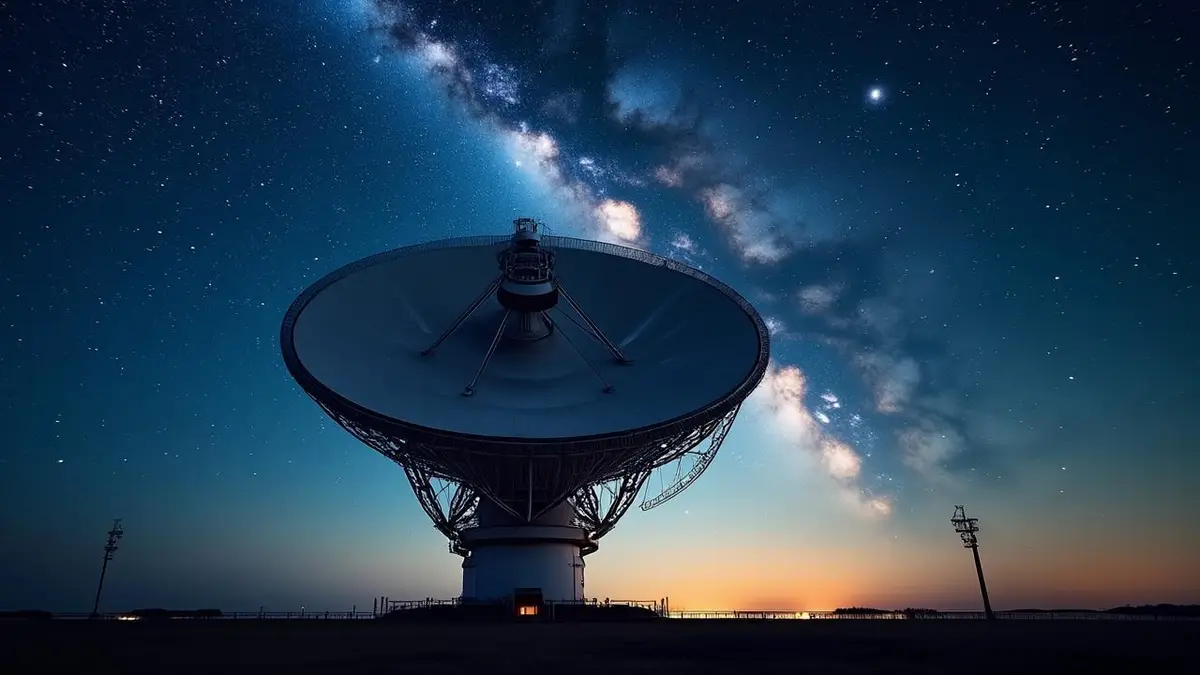
The instruments were the Five-hundred-meter Aperture Spherical radio Telescope, known as FAST, in Guizhou province, and the Dark Energy Spectroscopic Instrument, or DESI, in Arizona. FAST is the world’s largest single-dish radio telescope, and its sensitivity makes it unusually good at detecting faint hydrogen signals. DESI, meanwhile, maps millions of galaxies across enormous volumes of space. Together, they offer a way to compare star formation rates with the gas supply on the same cosmic timescale.
The result, published in the journal Nature Astronomy, is that the two do not fall in step. Star formation has weakened dramatically, but the neutral hydrogen reservoir has not dried up at the same rate. In other words, galaxies still contain plenty of the raw material for stars. What they seem to be losing is the ability to process it.
The finding shifts attention from supply to process. Gas must cool, clump and collapse under gravity before it can ignite into stars, and each of those steps can be disrupted. Outflows driven by exploding stars, heating from supermassive black holes, or the simple turbulence of a maturing galaxy could all make gas too warm or too diffuse to collapse efficiently. A galaxy can be gas-rich and still nearly sterile.
That reframing matters because it touches one of the central questions in galaxy evolution: why the universe’s star-forming era peaked billions of years ago and has been winding down ever since. If fuel exhaustion is not the main culprit, models of how galaxies grow, age and eventually go quiet will need to be revised.
For China’s astronomy community, the work is also a milestone in international collaboration. FAST was proposed and built in China, but its most valuable science increasingly comes from pairing it with instruments elsewhere. Radio observations can trace cold gas that optical surveys cannot see, while large spectroscopic surveys provide the statistical sample that a single telescope cannot assemble alone.
There is also a broader lesson for anyone watching the sky. Cosmic history is not a simple story of depletion, like a fire burning through its last logs. It looks more like a kitchen that still has ingredients on the shelves but has lost its cooks. Understanding why — and whether the slowdown is reversible in any galaxy — will keep astronomers busy for years, and it will keep teams like this one pointing their dishes and spectrographs at the same patches of sky.