Can You Climb a Beam of Light? A Physics Puzzle With a Punchline
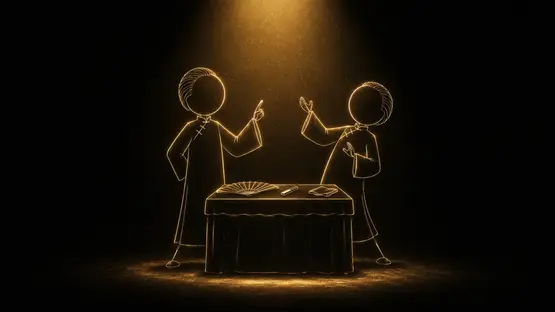
Two drunk men, one flashlight, and a dare: climb up the beam. One man switches on the light and challenges his companion to scale the glowing column. The other, no fool, replies that he would happily climb — except that halfway up, the other might flick the switch and drop him. The audience laughs, but the joke has been quietly nagging physicists for decades.
The routine is a staple of Chinese comic performance, popularized by the late crosstalk master Hou Baolin. It works because it takes a familiar image — a visible shaft of light — and treats it as a solid object. The first question is whether the beam is really there at all. In clean air, a flashlight beam is invisible; what we see is light scattering off dust, mist and smoke. The column is not a thing but a path, a stream of photons bouncing off particles and into your eye.
Suppose you could climb it anyway. Photons carry momentum, so a beam of light does push on whatever it strikes — the principle behind solar sails and optical tweezers, which use focused laser light to hold and move tiny objects. But the force is fantastically small. A pocket flashlight’s beam would exert a pressure far too feeble to support a human, or even a grain of sand, against gravity. You would need something closer to a stellar-scale searchlight.
Then comes the switch. Light travels at about 300,000 kilometers per second, so when the flashlight clicks off, the beam does not linger and fade like a smoke ring. The last photons race away almost instantly. Anyone perched on the beam would not be dropped by a vanishing column; they would simply find themselves in the dark, subject to ordinary gravity, and fall. In that sense the drunk man’s worry is well founded, if for the wrong reason.
Physicists have a more precise way to say it. Light is not a rigid ladder but a propagating electromagnetic wave. Its momentum is carried by the wave itself, and when the source stops, the wave stops being emitted. There is no leftover structure to stand on. The question of what happens to a beam after the switch is off is really a question about what light is: a thing, an event, or a description of how energy moves.
The puzzle also brushes against relativity. If you could ride the beam at light speed, the flashlight’s own frame would behave strangely — time dilation and the constancy of the speed of light make the idea of catching up to a photon slippery. Einstein famously imagined chasing a light beam as a teenager, and the thought experiment helped lead him toward special relativity. The drunk men, in their own way, are in good company.
So the answer is layered. You cannot see the beam without something to scatter it. You cannot stand on it because its push is negligible. And if the light goes out, you fall — not because the column was pulled away, but because it was never a column in the first place. The joke survives because the intuition it mocks is so stubborn: we treat light as a solid, when it is the most elusive thing we know.
That is why the bit keeps resurfacing in physics classrooms and popular science writing. It starts with a laugh and ends with momentum, scattering and the speed of light — a reminder that ordinary language about everyday things can hide extraordinary physics. The next time someone waves a flashlight, the beam is there, but only because something in the air is catching it.