Chinese Labs Explore Ceramics That Store Energy and Detect X-Rays
Two papers from Chinese materials labs, both circulating in scientific-blog summaries this week, point at the same quiet goal: making ceramics do more work under electrical stress. One focuses on storing energy; the other on turning X-rays into a readable signal. Neither is a product, but together they show where the country’s ferroelectric research is heading.
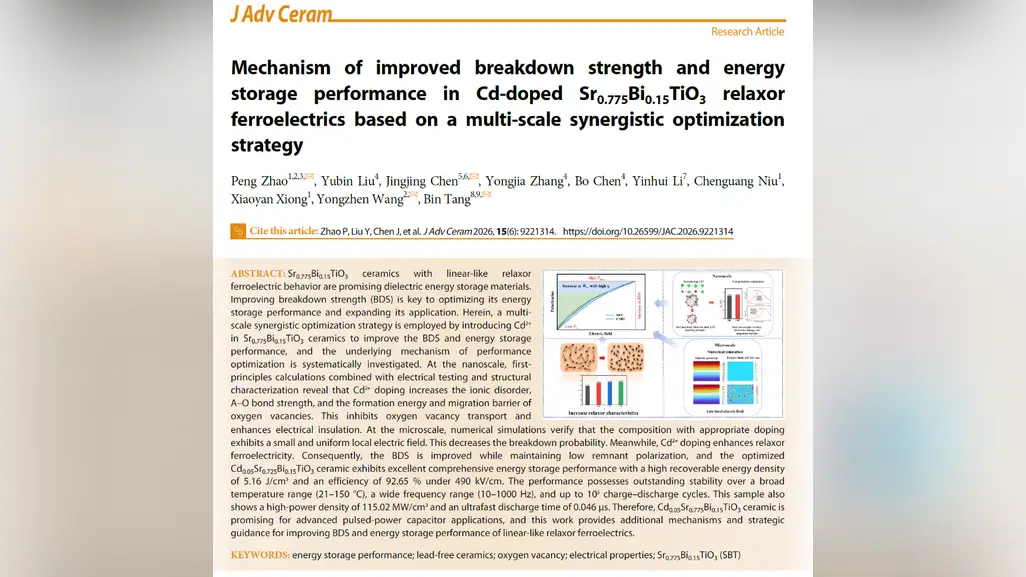
The first study, published in the Journal of Advanced Ceramics, examines a family of relaxor ferroelectrics built on strontium bismuth titanate, a ceramic whose crystal structure can be tuned to hold an electric charge and release it on demand. The authors, led by Zhao P. and Liu Y., doped the material with cadmium and report a mechanism that raises its breakdown strength — the voltage it can withstand before failing — while also improving how much energy it can store. For engineers, those two properties usually pull against each other: materials that hold more charge tend to fail sooner. A ceramic that improves both is the kind of result that matters for capacitors used in power electronics, where bulky components often limit how small a device can get.
The second paper, from a team at Southwest Jiaotong University and collaborators including Yang Weiqing and You Shihai, takes a different route. It describes a centimeter-scale wafer made of a two-dimensional ferroelectric perovskite, a layered material only a few atoms thick in each sheet. The challenge with such films is that their internal polarization tends to lie flat, which makes it hard for charge carriers to move between layers. The researchers report aligning that polarization out of plane, which boosts interlayer carrier transport and, in their tests, improves X-ray detection. The work appeared in the same ceramics journal.
Why does any of this matter beyond the lab bench? X-ray detectors built from such materials could eventually be lighter and more sensitive than the bulky panels used in medical imaging and industrial inspection. Energy-storage ceramics, meanwhile, sit inside everything from electric-vehicle power systems to grid equipment that smooths out surges. China already makes a large share of the world’s electronic components, so advances in the underlying materials tend to find their way into manufacturing faster than pure physics papers do.
The two results also share a method: both teams are engineering the internal structure of a crystal rather than inventing a new compound. That is a common pattern in applied materials science, where a modest tweak to how atoms line up can deliver more than a novel recipe. It also means the gains are incremental and hard to compare across labs, since breakdown strength and detection efficiency are measured under different conditions.
What remains unclear is scale. A centimeter-scale wafer is a laboratory sample, not a production line. The energy-storage ceramic is likewise a composition study, with no indication yet of how it behaves over thousands of charge cycles outside a controlled test. Readers should treat both as promising directions rather than finished devices.
Still, the direction is notable. Ferroelectric ceramics are an old field, but the push toward thinner, more ordered layers and better breakdown behavior reflects a broader appetite for materials that can handle higher voltages and tighter spaces. For a global audience, the takeaway is less about any single record and more about how quickly Chinese university labs are moving from composition experiments to device-relevant wafers.