China's New Fitness Craze: The Rise of 'Thin Muscle'
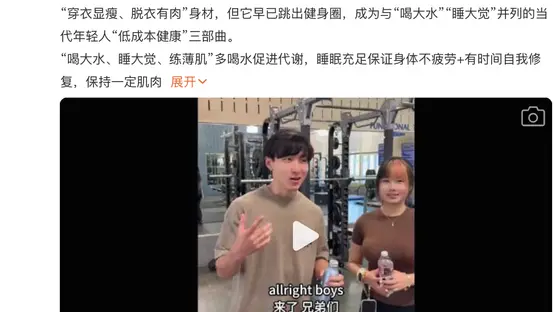
A new phrase has taken over Chinese social media: “thin muscle.” It does not appear in any sports-medicine textbook. It grew organically on platforms like Weibo, where posts tagged with the term show bodies that sit somewhere between the “paper-thin” look and the cartoonish bulk of a bodybuilder. The muscles are clean-lined, firm and compact, not exaggerated.
The concept is part of a broader mood. Search for the best way to live right now, and the advice flooding feeds is blunt and practical: build thin muscle, drink lots of water, sleep well. Most of these habits are simple. Building thin muscle, according to the people who promote it, is not. They say it requires precise coordination on several fronts at once, from training to diet to recovery.
That complexity is exactly what makes the trend interesting. It asks for visible muscle without the mass that traditional strength training produces. For many young urban Chinese, the appeal is aesthetic: clothes fit well, the silhouette stays slender, and the look reads as healthy rather than intimidating. The term has spread fast because it is easy to recognize in photos and hard to define in words.
Fitness culture in China has shifted several times in the past decade. Gyms expanded rapidly in major cities, then home workouts took off during periods when people stayed indoors. Running clubs and outdoor sports followed. The thin-muscle trend fits a generation that wants visible effort but not visible bulk, and that treats the body as a project to be optimized rather than a machine to be built.
There is a cautionary side. Social-media fitness trends can blur into body-image pressure, especially when the images are curated and the routines are vague. The thin-muscle label is loose enough that almost anyone can claim it, and the advice attached to it varies widely. Some posts emphasize strength and protein intake; others lean on calorie restriction dressed up as training.
Still, the conversation around thin muscle has opened a useful door. It has pushed people to talk about body composition rather than just weight, and about how muscle looks and functions at different levels of training. That is a more nuanced discussion than the old binary of skinny versus strong, and it has given fitness creators a new vocabulary to work with.
What happens next will depend on whether the term survives its own popularity. Trends that begin as personal goals often harden into rigid standards once they scale. The thin-muscle wave could settle into a sensible middle path, or it could become another set of rules that leaves people feeling they are not doing enough.