A Sun Wukong and Lin Daiyu Romance Is Rewriting Chinese Fan Fiction
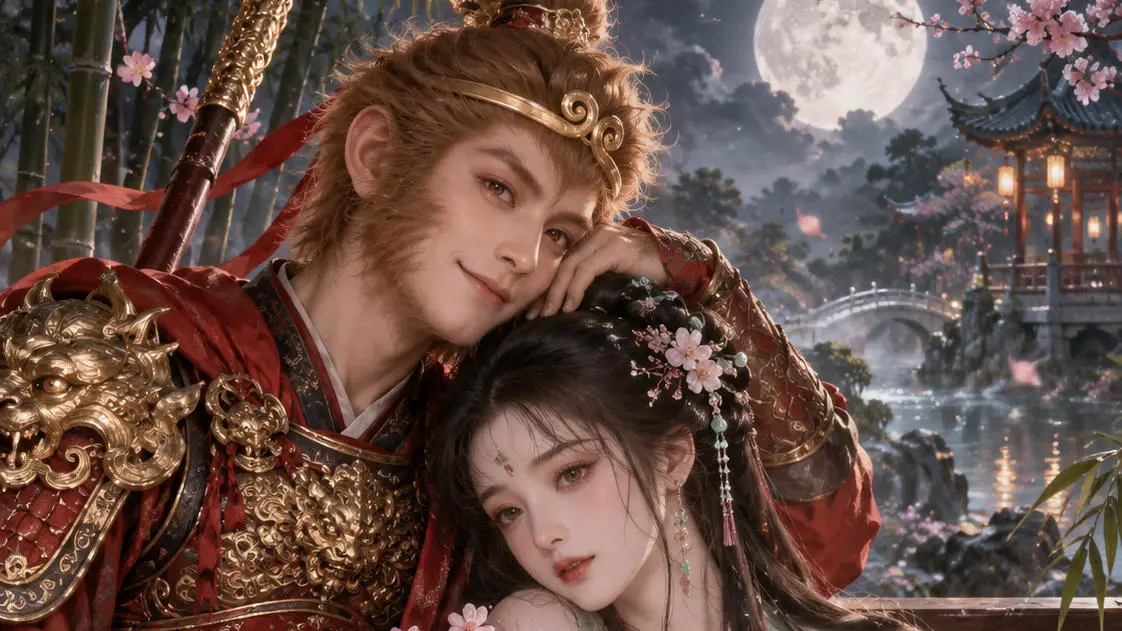
Sun Wukong, the shape-shifting Monkey King of Journey to the West, and Lin Daiyu, the frail, sharp-tongued poet of Dream of the Red Chamber, never meet in their respective novels. One is a sixteenth-century adventure about a pilgrim monk and his demon disciple; the other is an eighteenth-century family tragedy set inside a wealthy household’s garden. Yet the two have become one of the Chinese internet’s most talked-about romantic pairings, known as the Sheng-Dai cp — shorthand for a couple that fans want to see together.
The pairing did not start as mainstream news. It circulated for years inside fan communities, where writers and artists build stories around characters they love. The turning point came in 2025, when a reporter asked Liu Xiao Ling Tong, the actor most famous for playing Wukong in the beloved 1980s television adaptation, what he thought of the idea. He answered approvingly, and the pairing broke out of its niche and into wider awareness.
What has accelerated the boom more recently is the spread of AI tools that let almost anyone produce images, dialogue and short videos. Fans who once needed drawing skill or a writing habit can now generate scenes of the two characters in minutes. The result is a flood of content that is fast, cheap and endlessly varied — and a community whose boundaries are harder than ever to police.
The phrase fans use for their old ideal is quandichumeng, roughly enclosing a small patch of ground to nurture one’s own joy. It describes a subculture that keeps itself to itself, with its own etiquette and its own tolerance for strangeness. That enclosure is now under strain. Once a pairing reaches mainstream platforms, it draws in people who have read neither novel, plus advertisers and content farms looking for a trend to ride.
For the fans who built the pairing, the tension is familiar. Attention brings visibility and new participants, but it also brings commercial pressure and outside judgment. Older members worry that the playful, rebellious spirit that made the community fun is being flattened into a product — or worse, that the characters themselves get lost as they are remixed for clicks.
The two source novels remain among the most adapted works in Chinese culture. Journey to the West has spawned countless television series, films and games, including the recent wave of action titles built around the Monkey King. Dream of the Red Chamber is studied in schools and dramatized constantly. That makes their characters unusually available for reinvention — and unusually loaded with meaning for readers who grew up with them.
AI has made the reinvention faster but also less controlled. Fans describe a shift from careful, hand-made tributes to volume-driven output, where the goal is engagement rather than craft. Some welcome the accessibility; others see the same dynamic that has unsettled creative industries elsewhere, where tools lower the barrier to entry and then flood the market.
What happens next will be decided in the communities themselves. Fan groups are experimenting with rules about credit, about what counts as respectful use of a character, and about how to keep a space for the odd, unpolished work that made the pairing interesting in the first place. Whether that etiquette can survive the traffic is the question every fan subculture now faces.