A 20-Year-Old CRT Monitor Is the Best Way to Play Morrowind
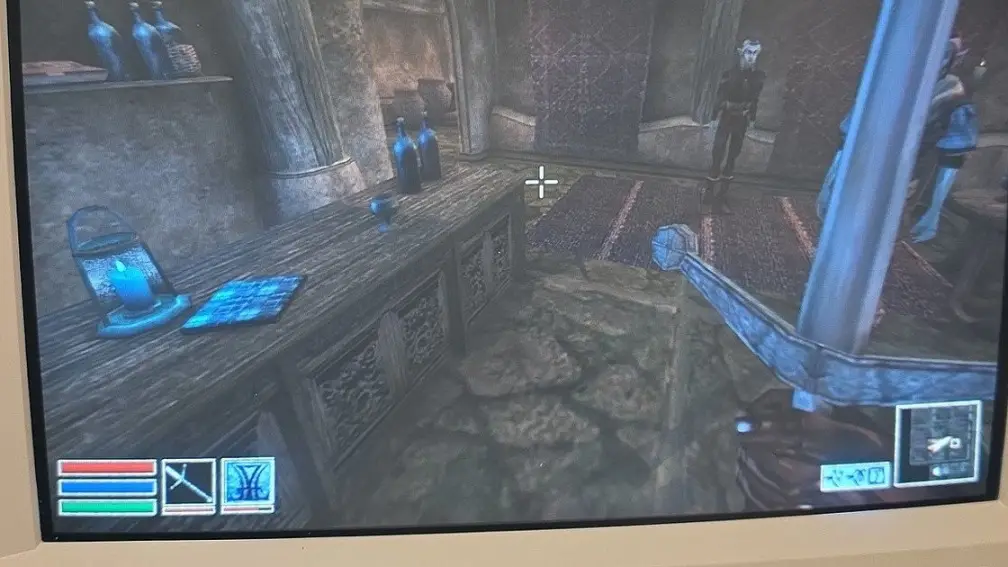
A photograph posted on Reddit has pulled thousands of players back two decades: someone running The Elder Scrolls 3: Morrowind on a convex glass CRT monitor, the kind of heavy, humming, flickering display that once took up half a desk. The scene shows Balmora, the first big city players reach after landing at Seyda Neen, and the interface size suggests the screen is running at 800x600 or 1024x768 — exactly the resolutions the game was designed around when it launched on PC in 2002.
The nostalgia is easy to understand, but the surprising part is that the old hardware may genuinely be the better fit. Morrowind was built for the 4:3 aspect ratio and low resolutions of its era. Its interface, fonts and textures were drawn to be read on a soft, glowing tube rather than a sharp modern panel. Stretch that same game across a 27-inch widescreen LCD and the user interface becomes tiny, the text turns into a squint test, and the low-resolution artwork is exposed in ways its artists never intended.
A CRT solves several of those problems at once. Because the display can render non-native resolutions without the blurry interpolation an LCD applies, 800x600 fills the screen cleanly and the pixels stay crisp. The natural softness of the tube also hides the jagged edges of early-2000s 3D models in a way that modern anti-aliasing never quite replicates. And the near-instant response of a cathode-ray tube, with essentially no input lag, flatters the timing of older action games.
The trade-offs are just as real. CRT monitors are heavy, often weighing 20 kilograms or more, they consume far more power than a modern display, and finding one in working condition in 2026 means digging through secondhand markets and hoping the capacitors still hold. Refresh flicker can cause eye strain, and the geometry of the picture often warps slightly at the edges. For most players, an emulator filter or a resolution-scaling mod is the practical compromise.
What the photo really captures is a wider mood in games culture. Retro hardware has become its own hobby, with collectors hunting down old consoles, mechanical keyboards and now monitors. The appeal is partly authenticity and partly a reaction against the relentless push for sharper, faster, more expensive screens. Playing Morrowind the way it looked in 2002 is a way of meeting a beloved game on its own terms.
Morrowind itself remains a landmark. Its strange, ash-covered island of Vvardenfell, its dense text-based dialogue and its refusal to hold the player’s hand made it a cult favorite long before later entries in the series became mass-market hits. Fans still argue about which version is definitive, and the CRT crowd now has a strong claim: the one that looks like it did on the desk of a 2002 PC owner.
None of this means anyone should rush out and buy a 20-kilogram monitor. But the next time an old game looks wrong on a modern screen, the reason may not be the game. It may simply be that the hardware moved on, and the game was never invited along.