China's First AI-Made Feature Film Tests What Audiences Will Accept
On October 23, a film called Sanxingdui: Future Past opened in Chinese cinemas with a distinction no other feature has carried: it is the first AI-made feature film to receive a Chinese theatrical release certificate, the permit known as a dragon label, and sell tickets to the public. The film was produced by Bona Film Group, the studio behind big commercial hits such as The Battle at Lake Changjin and Operation Red Sea, through an AI production center it set up at the end of 2023.
The title places the film in the universe of The Three-Body Problem, the science-fiction novel by Liu Cixin that has become one of China’s most exported cultural properties. Its story reaches back to Sanxingdui, the Bronze Age archaeological site in Sichuan province whose strange bronze masks and figures have fascinated Chinese audiences for decades. That pairing of ancient mystery and futuristic technology is the film’s central selling point.
According to the production team, the work took two years on a self-developed platform the studio calls the Boka Film Cloud Studio. The team generated more than 1.2 million base images, drew on nearly a hundred people, and spent in the tens of millions of yuan. That is a modest budget by the standards of Chinese blockbusters, but far above the cost of the short AI clips that have flooded social media in the past two years.
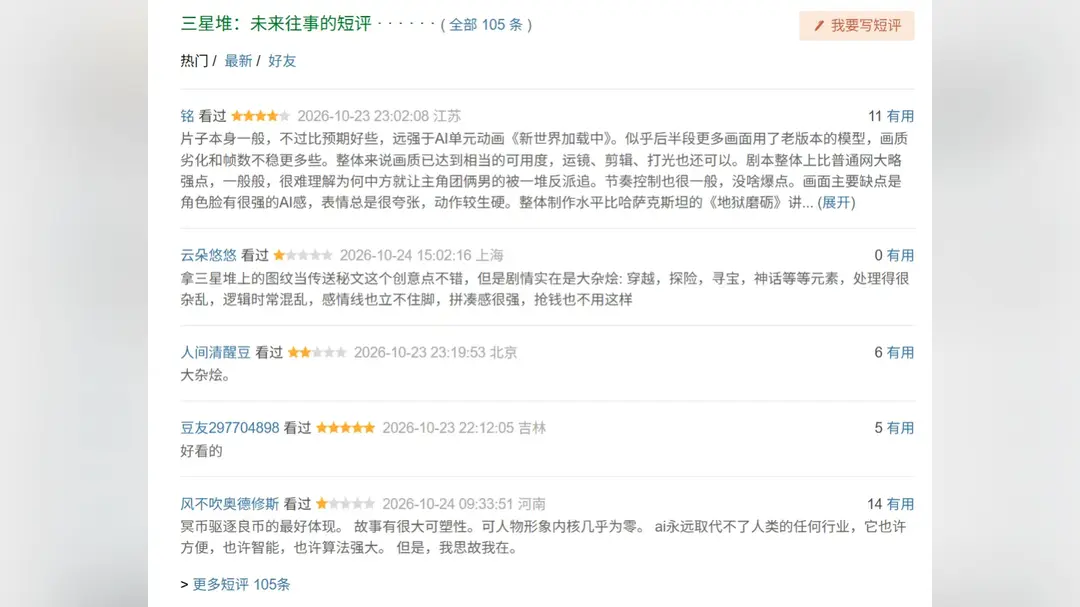
The result, as described by early viewers and critics, is a film of striking surfaces and limited life. The images are often beautiful, but faces stay oddly unchanged from shot to shot, and the civilizations on screen feel simplified, as if reduced to a handful of visual motifs. The technology can render a crowd or a temple, but it struggles with the small human irregularities that make a character feel real.
That tension is the real subject of the release. For the past two years, Chinese studios have used AI to make comic dramas, advertisements and short videos at a fraction of traditional costs. Feature-length cinema is a harder test, because audiences pay for a ticket and expect a coherent story, not a demonstration. The film’s opening weekend will be read across the industry as a signal of whether AI can carry a mainstream release or remains a tool for parts of the pipeline.
Bona’s decision to put its name and a theatrical release behind the project is notable. Established studios have mostly experimented quietly, using AI for storyboards, concept art or visual effects cleanup. Releasing a fully AI-made feature gives the technology a public face and invites comparison with conventional filmmaking, which may be uncomfortable if audiences stay away.
The film also raises questions that Chinese cinema will have to answer soon: how credit is assigned when images are generated rather than shot, how actors and designers are compensated, and whether the dragon label should treat AI-made films differently from live-action ones. None of these has been settled, and the release is likely to accelerate the debate.
For global viewers, Sanxingdui: Future Past is a preview of a future that Hollywood and other film industries are also approaching, but with a different set of constraints. China has a large, fast-moving AI video sector, strong state interest in cultural technology, and a huge domestic audience. Whether this film becomes a curiosity or a template will depend on the next few weeks at the box office, and on whether the next AI feature learns to make its people move.