A 970-Year-Old Wooden Pagoda and the Limits of Repair
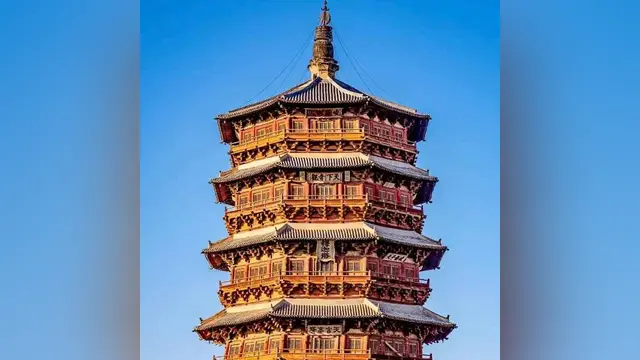
The Sakyamuni Pagoda in Yingxian, a small county in Shanxi province, has stood for nearly a thousand years without a single nail. Built in 1056 during the Liao dynasty, the wooden tower rises 67.31 metres, with five visible storeys wrapped around nine structural layers — open floors alternating with hidden bracing levels packed between them. It is the oldest and tallest all-wood pagoda still standing anywhere, and for decades engineers have called it a patient in slow decline.
The diagnosis, as laid out in an answer that has circulated widely on the Chinese question-and-answer site Zhihu, is concentrated on the second open storey. The inner and outer rings of columns on its southwest side keep tilting, some visibly out of plumb. The bracket sets that carry the load above have begun to crush at their ends. Of the twelve or more severely damaged bracket assemblies across the tower, eight sit in this one storey.
The author, writing under the name Jianzhuxue, argues that repairing the pagoda is not a structural question at all but a full medical consultation — and that the basic sciences it depends on are not yet built. Physiology, pathology and pharmacology, in this metaphor, are all incomplete. Nobody can yet model precisely how a nine-layer timber frame distributes load as its members creep and crack over centuries, how ancient larch and elm behave when they dry and split, or which intervention actually arrests the tilt rather than shifting stress elsewhere.
The temptation is to prop, straighten and replace. Each option carries a cost the building cannot absorb twice. Straightening a leaning column can transfer force to brackets that are already at their limit. Replacing rotten timber means cutting into a structure whose value lies partly in the fact that its original members are still doing their job. And any repair must survive not just the next century but the earthquakes, humidity cycles and tourist traffic that the next century will bring.
What makes the case compelling beyond China is that it is a preview. The world is full of irreplaceable structures — cathedrals, temples, early concrete landmarks — now entering the age when their original materials are failing faster than the science of conserving them matures. The pagoda is unusual only in how honestly its custodians talk about the gap.
For travellers, Yingxian is a detour rather than a headline stop, a county town west of the Wutai mountains that most visitors reach by road. The pagoda rewards the trip precisely because it is not restored to a gleaming finish. Its timber is dark, patched and visibly tired, and the lean is real.
The question now is not whether to intervene but how. Conservation teams have debated schemes for years, from targeted reinforcement of the second storey to a full dismantling that most experts resist. Watch for whether authorities commit to a defined repair plan, and whether the monitoring data from the tower’s instruments is ever published in full — the clearest sign that the patient’s chart is finally being read.