Harvard and Google Study: GPT-6 Astra Solves 98% of Physics Problems
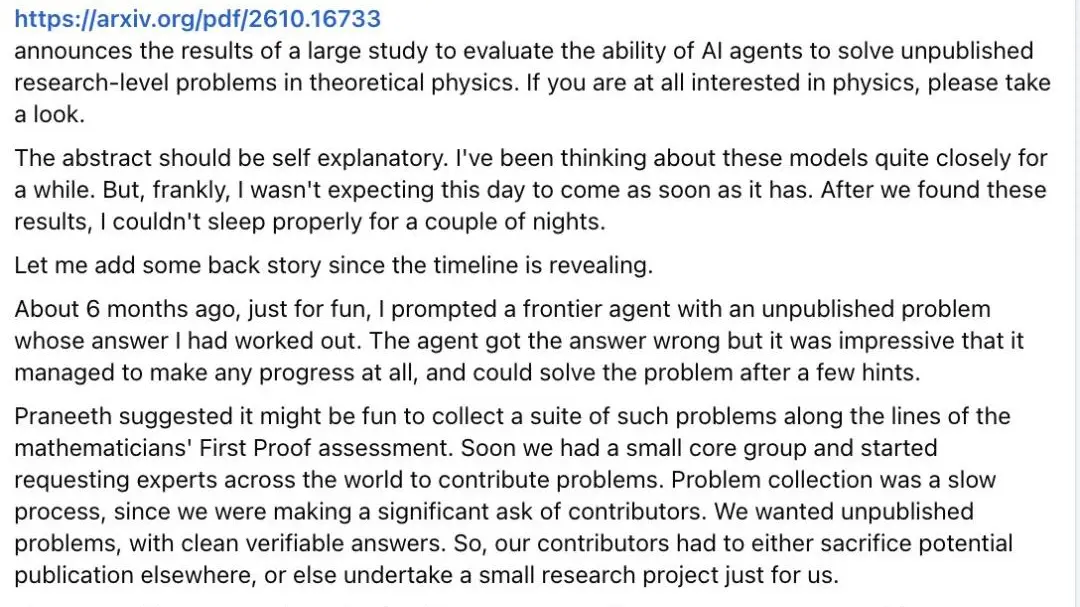
A research collaboration between Harvard and Google has set off a stir in academic circles with a benchmark that tests frontier AI on unpublished theoretical physics problems. According to reports circulating in Chinese tech media, the evaluation, called TheoPhysEval, asked advanced models to tackle fresh problems that top human experts reportedly need a full day to solve. The standout performer was a model referred to as GPT-6 Astra, which reportedly solved 98% of the problems.
The most striking detail is not the near-perfect score but how the model got there. Reports say GPT-6 Astra initially scored 88%, then flagged a calculation error in one of the problems set by the human experts who designed the test. After the experts reviewed and acknowledged the mistake, the model’s score rose to 98%. That anecdote, if accurate, marks a symbolic moment: an AI system not only answering a frontier question but correcting the people who wrote it.
TheoPhysEval is designed to avoid the contamination problem that plagues many AI benchmarks. Instead of drawing on published papers that models may have seen during training, it uses unpublished, freshly written problems. The idea is to test genuine reasoning rather than recall. If a model can work through novel theoretical physics without having encountered the exact problem before, that suggests a more general capability.
The result arrives amid a broader acceleration in AI’s mathematical and scientific abilities. In early October, OpenAI claimed that its systems had proved a quasi-Riemann hypothesis, a result that mathematicians described as Fields Medal-worthy if produced by a human. Within days, researchers reported that, with AI assistance, mathematicians had proved a form of the generalized Riemann hypothesis. The pace has left some academics exhilarated and others uneasy.
MIT researchers have also weighed in, with reports citing their own tests showing that frontier AI has made rapid gains in solving theoretical science problems over the past two years. The trend lines suggest that AI is shifting from a tool that assists scientists to a participant that can propose and check results. That shift raises questions about how credit, verification and peer review should work when a machine is in the loop.
Skeptics caution that benchmark results can be overstated, especially when details are filtered through press coverage rather than peer-reviewed papers. The exact composition of TheoPhysEval, the number of problems tested, and the independence of the evaluation have not been fully detailed in public. Until the methodology is published and replicated, the 98% figure should be treated as a claim to watch rather than a settled fact.
Still, the story captures a mood. For decades, theoretical physics has been among the most human of pursuits, requiring intuition, mathematical fluency and years of training. A model that can reportedly spot an expert’s arithmetic slip suggests those walls are lower than many assumed. Whether this is a breakthrough or a well-timed headline, the conversation about AI in science has moved from whether it can help to how much of the work it will eventually do.