Tesla's Flying Roadster Redefines What a Car Can Do
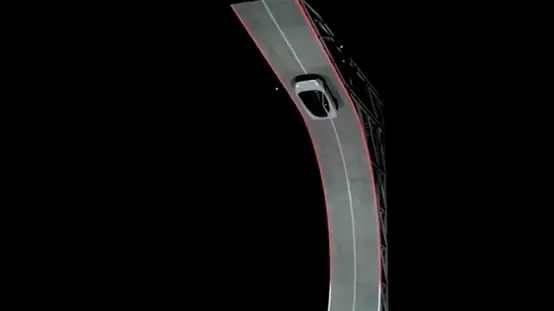
In the dark of a Texas test ground next to SpaceX’s rocket facilities, a silver-gray car lifted off a curved ramp, rolled once in the air, and landed cleanly, white jets of gas trailing behind it. This was not a film effect. It was the real-world debut of Tesla’s second-generation Roadster, a pure electric sports car that had been promised for nearly a decade and mocked in its early years as a PowerPoint fantasy.
The demonstration, held on October 16, showed the car performing feats no production vehicle has attempted: driving upside down, hovering briefly above a row of cars, and rotating in mid-air before touching down. The key is a cold-gas thruster system mounted at the rear and around the body. Elon Musk has long run both SpaceX, the rocket company, and Tesla, the car and robot maker. In the Roadster, those two worlds finally meet, borrowing technology originally designed for spacecraft to give a road car abilities that seem to belong in science fiction.
Reaction was immediate. Videos from the event climbed Chinese social media trending lists within hours. Even observers who had grown tired of the sameness of the electric vehicle market found it hard to look away. The presentation felt less like a product launch and more like an aerospace experiment staged for a crowd.
Musk’s framing of the car was as striking as its performance. He described it as one of the last great human-driven cars, a line that reads as a confession about how long fully self-driving cars are actually taking to arrive. The Roadster does not depend on profit margins or regulatory approval. It depends on physics and spectacle, and on reminding the world who gets to define what counts as a technological frontier.
The timing matters. The global auto industry has converged on similar designs, similar battery ranges, and similar marketing language. A car that flies, even briefly, cuts through that noise. It also raises questions. How much of the demonstration will reach customers? What does a cold-gas system mean for safety, weight, and cost? Tesla has not answered those questions in detail, and the car remains a statement piece as much as a product.
Still, the engineering itself deserves attention. Cold-gas thrusters are simple compared with rocket engines, but integrating them into a vehicle that must also pass crash tests and road regulations is a serious challenge. The fact that Tesla built a working demonstrator suggests the company is treating the project as more than a publicity stunt.
For the wider electric vehicle world, the message is uncomfortable and exciting at once. Chinese automakers have spent years closing the gap with Tesla on price, range, and software. Now Tesla has opened a new category that no one else is competing in. Whether or not the flying Roadster ever becomes a mass product, it has changed the conversation about what an electric car can be.