A Light-Up Hydrogel Takes Aim at a Rare Eye Cancer
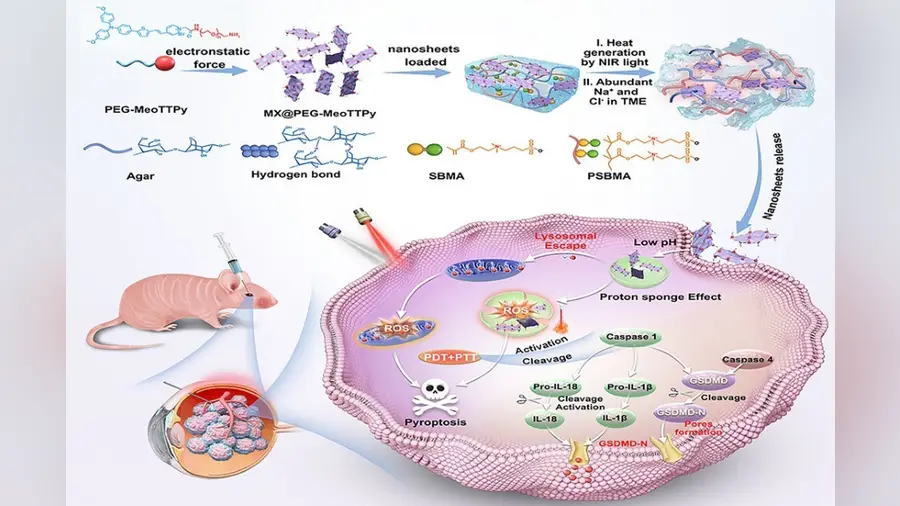
Choroidal melanoma is one of those cancers most people have never heard of until it touches their family. It grows in the choroid, the layer of blood vessels between the retina and the white of the eye, and it is the most common primary cancer inside the adult eye. Treatment often means radiation or removing the eye altogether, and the disease can spread to the liver years later. A team of Chinese researchers has now published a materials-based approach that tries to attack the tumor with chemistry rather than surgery.
The design, described in a paper whose author list includes Yingni Xu, Fei Wang, Wenfang Liu and Qi Zhao, combines two familiar ideas from the lab. One is a class of molecules known as aggregation-induced-emission luminogens, or AIEgens. Many fluorescent dyes go dim when they clump together; AIEgens do the opposite and glow more brightly in a crowded state, which makes them useful for imaging and for generating reactive oxygen species under light. The other is MXene, a family of ultrathin two-dimensional sheets that conduct heat and electricity well and can absorb near-infrared light.
The researchers attached the glowing molecules to MXene nanosheets and dispersed the result in a hydrogel, a water-rich polymer gel that can be injected or applied locally. When the gel is exposed to near-infrared light, the MXene converts the light into heat, and the AIEgens respond by producing reactive oxygen species. That combination of mild heat and chemical stress is the trigger the team wants.
The target of that trigger is pyroptosis, a form of programmed cell death that is different from the quiet, tidy apoptosis most cells undergo. Pyroptosis makes a cell swell and burst, spilling its contents and sending alarm signals to nearby immune cells. Cancer researchers have become interested in it because it can turn a tumor into something the immune system notices, rather than a silent mass that grows unchallenged.
The appeal of a stimuli-responsive hydrogel here is localization. The eye is a small, delicate, enclosed space, and systemic chemotherapy is poorly suited to it. A gel placed near the tumor and switched on by an external light source could, in principle, treat the lesion while sparing surrounding tissue. The paper’s title frames the work exactly this way: a stimuli-responsive hydrogel for pyroptosis-mediated therapy of choroidal melanoma.
It is worth being clear about what this is and is not. The work is a laboratory study, likely built on cell cultures and animal models, and the gap between a promising hydrogel in a dish and a treatment used in an eye clinic is wide. Dosimetry, light penetration through ocular tissue, biocompatibility of MXene sheets and long-term safety all remain open questions. MXenes are also a young material family, and their behavior inside living tissue is still being mapped.
Still, the direction is telling. AIEgens and MXenes are both products of the past decade of materials science, and this paper shows them being stitched together with a specific clinical problem in mind. The same logic, light-triggered heat plus reactive oxygen, is being explored against skin, breast and other tumors. A rare eye cancer is a demanding test case because the margin for error is so small.
For patients, nothing changes yet. For the field, the interesting part is the blueprint: a material that stays inert until switched on, then kills cells in a way that may recruit the immune system. Whether that blueprint survives animal studies and early human trials is the question that matters, and it will take years to answer.