The White Trail Behind Painted Cranes Isn't Cloud — It's Bird Droppings
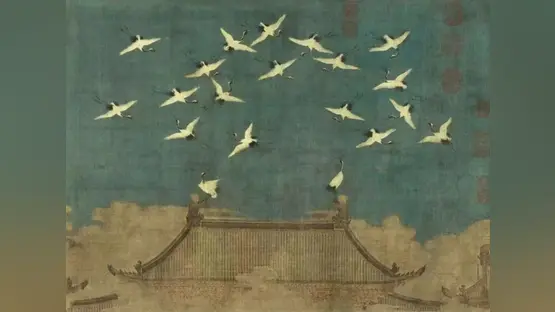
Look closely at a classical Chinese flower-and-bird painting and you may notice a delicate white ribbon trailing behind a flying crane, curling in the wind like a wisp of auspicious cloud. It is a charming detail, and for centuries viewers have read it as a symbol of good fortune attached to a bird that Chinese tradition treats as a minor immortal.
A recent post from a Chinese science account has politely ruined the illusion. That ribbon, it explains, is not cloud at all. It is what a crane produces in flight — the painter, in other words, was a realist.
The example the post leans on is the most famous crane painting in Chinese art: Auspicious Cranes, a handscroll by Emperor Huizong of the Northern Song dynasty, dated to the early twelfth century. The emperor was himself a celebrated painter and calligrapher, and the scroll records a real event: a flock of cranes circling over the palace in the capital, taken at the time as a sign of good governance. Huizong painted the birds with an attention to plumage, posture and flight that still impresses ornithologists.
That attention is exactly the point. In the wild, a large bird in sustained flight does not stop to land for every bodily function; waste is expelled as it goes, and on a crane the result is a long, pale streak that hangs briefly in the air behind the tail. Anyone who has spent time birdwatching — the post notes that many enthusiasts have been on the receiving end — will recognise the shape.
For a modern reader the joke lands because it inverts the usual way we look at old paintings. We tend to treat pre-modern art as symbolic first and observational second, assuming that a decorative flourish must mean something. Here the flourish means something only because it was seen. The painter was not decorating the crane; he was drawing what a crane looks like from below.
That reading fits a broader pattern in Chinese bird-and-flower painting, a genre that flourished from the Song dynasty onward and prized what critics called xiesheng, or writing life — catching a subject’s living character rather than merely its outline. Song-era painters were famous for studying animals closely: feathers, claws, the angle of a wing in a turn. The white streak is a small, slightly rude proof of that habit.
The post does not name a specific new study or exhibition; it is a piece of science communication aimed at general readers, and its pleasure is the pleasure of a second look. The next time a museum label explains the auspicious cloud behind a crane, a visitor may find themselves quietly disagreeing.
It is also a reminder that the boundary between decoration and documentation is thinner than it looks. A detail that reads as pure ornament to one century can read as field observation to another — and the birds, as ever, were doing exactly what birds do, whether or not the court painter chose to show it.