Why Rubbing a Strand of Hair Curls It Into a Tiny Spring
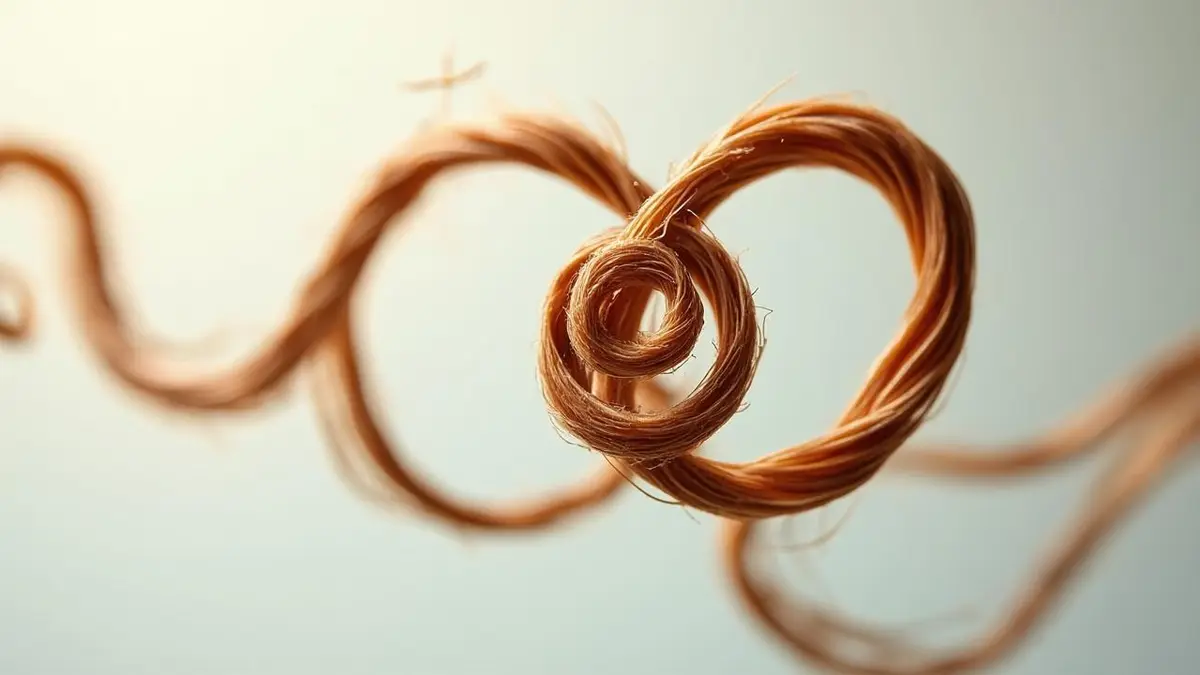
Pick up a single strand of hair, pinch one end, and drag your thumbnail along its length. Let go. The tip does not stay straight — it twists into a small, tight coil, like a spring you might find inside a retractable pen. It is an odd little party trick that costs nothing and works almost every time.
At first glance, this makes no sense. If you only pull a material along its length, it should stretch, not curl sideways. A rubber band pulled straight does not suddenly bend into a spiral. So what is hair doing?
The answer starts with structure. Hair is not a simple solid rod. It is built mostly from keratin, a protein that assembles into long, rope-like fibres. Those fibres are packed inside the hair shaft in a twisted arrangement, a bit like the strands of a cable. When you drag your nail across the surface, you are not pulling evenly. You scrape one side more than the other, creating a mismatch between the side under tension and the side left alone.
The side that is stretched becomes slightly longer and thinner. The other side stays put. Because the two sides now have different lengths, the strand has no choice but to bend toward the shorter side — the same way a bi-metal strip curls when one layer expands more than the other. Do this repeatedly along the length, and the bends accumulate into a helix.
There is a second effect at work, too. Keratin fibres have a preferred direction of twist, and hair has a natural tendency to coil when compressed. Stretching one edge while the rest resists creates a torque, a twisting force, along the shaft. Once the strand is released, the stored energy unwinds into a neat spiral rather than a random tangle.
The result depends on your hair. Fine, straight hair tends to coil tightly and evenly. Thick or chemically treated hair — bleached, permed or relaxed — may kink unpredictably or snap, because the internal protein structure has already been damaged. Humidity matters as well: damp hair is more elastic because water molecules slip between the keratin fibres and loosen their bonds.
Researchers who study hair biomechanics find this behaviour useful. The same principles explain why hair tangles, why split ends form, and why a strand can act like a tiny torsion spring in textile and materials research. Some laboratories have even studied hair-inspired coils as models for flexible sensors and soft robots.
So next time you find a loose hair on your sleeve, try it. Pinch, pull, release. What looks like a throwaway moment is actually a small demonstration of materials science — and a reminder that everyday objects, examined closely, rarely behave the way our intuition says they should.