Chinese Robot Brains Draw Big Money as World Models Take Off
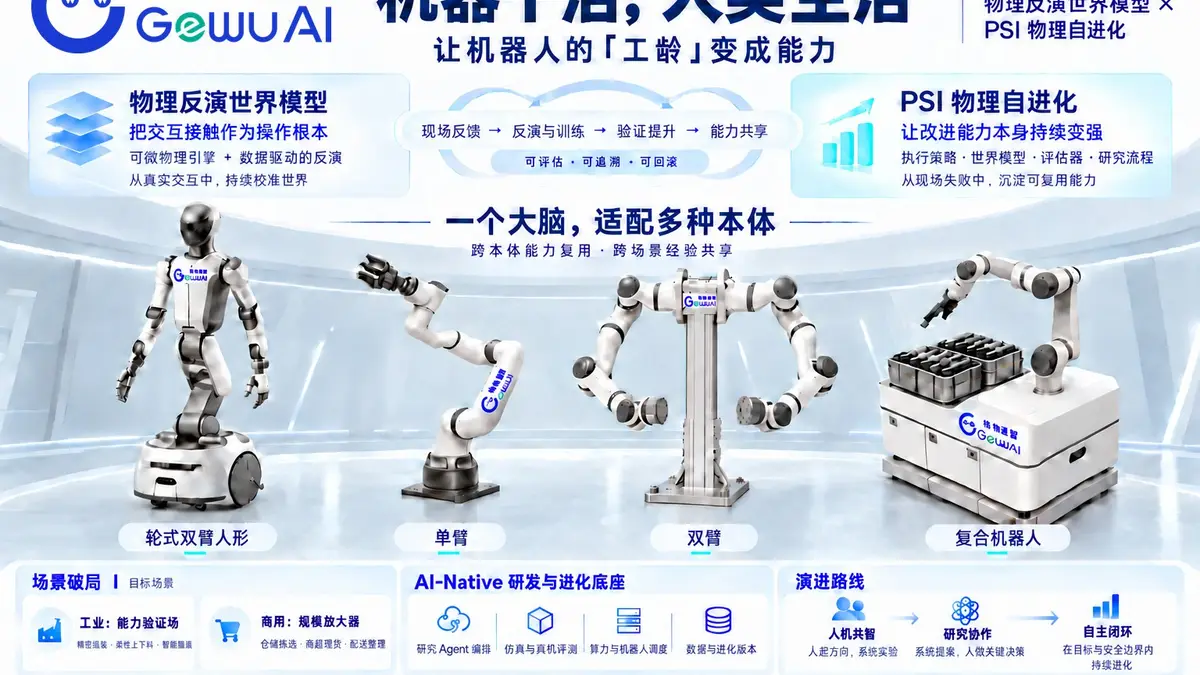
A quiet corner of China’s AI scene is suddenly drawing serious money. Two young companies working on so-called world models — AI systems that learn how physical space behaves so machines can predict what happens next — have closed funding rounds within days of each other, a sign that investors see the next big AI opportunity in robots rather than chatbots.
The first, Gewu Tongzhi, said it raised nearly 100 million yuan in a angel round. The Hangzhou-based company was founded in August 2026 and is building what it calls a physical inverse world model, trained on large-scale data so a robot can reason about objects, motion and consequences before making a move. Backers include local government-linked funds and several listed companies, and the money will go toward bigger pretraining runs, hardware, hiring and real-world testing across several scenarios.
Its founder has a notable pedigree: he previously led the world-model foundation team inside Huawei’s intelligent automotive unit, one of the most closely watched AI operations in the country. That background helps explain why the company attracted attention so soon after launch — in China’s crowded AI field, a track record at a major player is often worth more than a business plan.
The second startup, Wuyuan Technology, was founded by Wu Haixu, a Tsinghua University standout who won the school’s prestigious special scholarship in 2022 and was a lead author on GeoPT, a research project on physical world modeling. The company has already completed several funding rounds and reached a valuation in the hundreds of millions of dollars, according to reports, with a roster of well-known investors.
The common thread is a shift in how engineers think about robot intelligence. For years the focus was on vision-language-action models, which let a machine understand a scene and carry out a command. A world model adds something different: the ability to mentally rehearse. Instead of simply recognizing a shelf of medicine boxes, a robot can simulate the grip, predict the slip and adjust before the arm moves.
That capability matters most in messy real-world settings — pharmacies, warehouses, factories — where objects look alike and lighting changes. One Shanghai-based team working in a pharmacy described robots that pick similar-looking packages from crowded shelves, a task that demands prediction as much as perception. Proponents argue that combining world models with vision-language-action systems gives machines something closer to an embodied brain: one part decides what to do, the other checks whether it will work.
The enthusiasm comes with caveats. Training world models is data-hungry and expensive, and nobody has yet shown a clear path to mass deployment. Some of the most hyped humanoid and surgical robotics ventures abroad have struggled or failed outright, a reminder that hardware timelines are unforgiving. But the direction of travel is clear: AI money in China is moving from screens to the physical world, and the founders with the right research credentials are finding capital waiting.