A Tianjin Crosstalk Veteran Booed Onstage, Then a Debt Record Surfaces
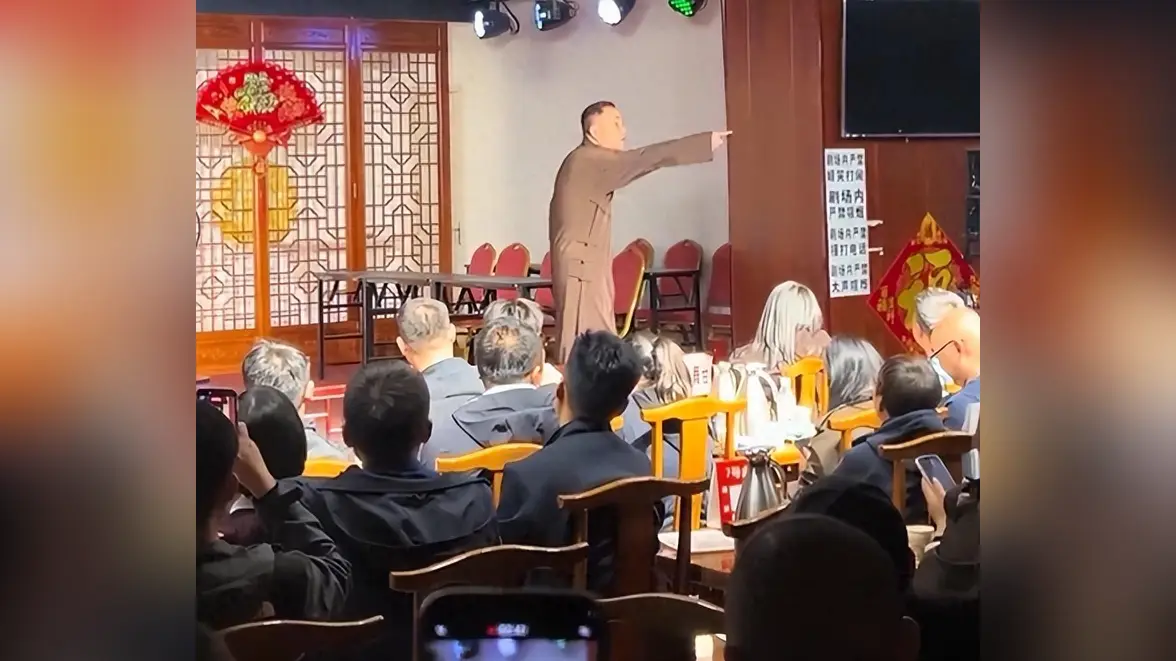
On the evening of October 25, at a Tianjin venue run by Yang Guang Crosstalk Society, the closing act was a man who has taught the craft for four decades. Someone near the back of the hall called out a nickname, Yang Laowu. According to accounts circulating online, the performer’s face changed and he fired back at the heckler, asking the room whether the shout was right, and at one point threatening to call the police. Video of the exchange spread quickly.
Within a day, a second item surfaced: a court record listing him among China’s shixin bei zhixing ren, the people courts flag for failing to honour judgments. The figure attached was 3.74 million yuan. For readers outside China, that designation is not a criminal conviction. It is a civil enforcement listing used when a debtor has the means but not the willingness to pay, and it can restrict travel, high-speed rail seats and spending.
Crosstalk, or xiangsheng, is a two-man stand-up form built on rapid banter, dialect and stock comic routines. It remains a fixture of Tianjin, a port city that treats comedy as civic identity. Yang Yi grew up inside that world as the son of Yang Shaohua, a much-loved performer. Being a famous man’s son is its own trap in a scene where audiences measure heirs against fathers, and where nicknames carry both affection and contempt.
The timing is what hurts. A heckle is survivable; performers handle drunk and rowdy rooms every week. What is not survivable is a heckle followed by a financial record, because the two reinforce each other. A performer who shouts down a paying customer looks thin-skinned, and a performer with an unpaid judgment looks like someone who does not settle debts. Put together, the audience’s patience evaporates.
Online reaction has split along predictable lines. Some fans defended him as a teacher defending his stage. Others argued that a man who has spent forty years reading a crowd should know that a nickname is not the insult, losing composure is. The debt record did more damage than the outburst, since it turns a bad night into a question about character.
This is a familiar arc in Chinese entertainment: a regional celebrity, a loyal local following, a viral moment that travels far beyond the original audience. The mechanics of that spread matter. A clip that would once have stayed inside a 300-seat hall now reaches millions who have never heard a crosstalk set and who judge the man entirely by ten seconds of temper.
Recovery is possible but narrow. The usual route is a public apology without excuses, a quiet settlement with creditors, and a return to small rooms where reputations are actually rebuilt. The risk is doubling down. Every extra day of defiance gives the clip another cycle of life.
What happens next will be watched less by comedy fans than by venue owners and promoters, who price risk. If bookings hold, the episode becomes a footnote. If they thin out, it becomes a lesson about how quickly a forty-year career can be redefined by one shout from the back row.