A Chinese Lake, a Vanishing Crane, and the Value of Counting
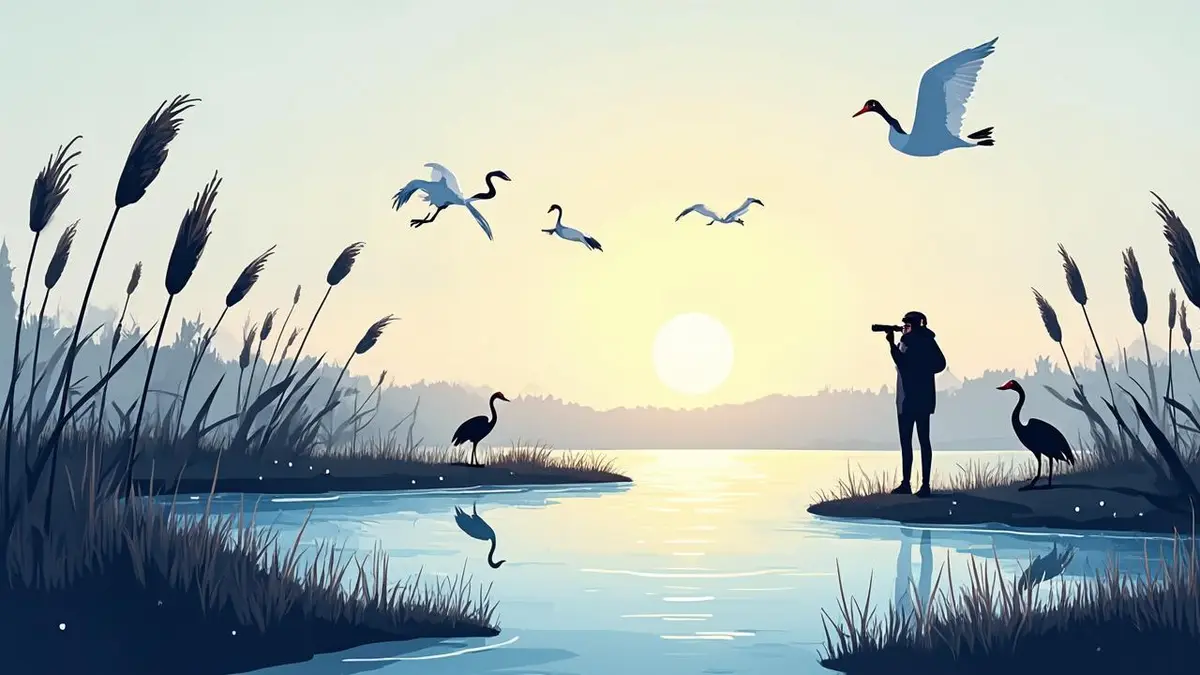
Every winter, a shallow lake on the middle reaches of the Yangtze River fills with waterbirds. Longgan Lake, straddling Hubei and Anhui provinces, is one of the most important wintering sites for waterfowl along the Yangtze, and among its visitors is the hooded crane, a species listed as first-class protected wildlife in China. After the rice harvest, spilled grain in the paddies, muddy shallows and exposed lake shore give the cranes food and a place to rest.
The question that drove decades of work there was simple to state and hard to answer: as the climate shifts and human activity presses in, are the cranes’ wintering numbers and their distribution across the lake changing? Answering it required the least glamorous tool in ecology, a notebook, a pair of binoculars and somebody willing to return to the same spots year after year.
That somebody was Hu Hongxing, an ecology professor whose students remember him as much for his insistence on showing up as for his lectures. His point was that a single winter tells you almost nothing. A population can swing on weather, on food, on where the birds happened to settle that season. Only a run of consistent records, taken the same way at the same places, can separate a real trend from noise.
For the students who joined him, the fieldwork was a lesson in patience. Days on the lake could be cold and empty. The payoff was not a dramatic discovery but a line on a chart that slowly became trustworthy. One former student recalls the routine with affection: the same trails, the same count, the same quiet satisfaction when a familiar flock appeared where it was expected.
That is the unglamorous core of conservation science. Satellite tags and genetic sampling make headlines, but the long-term ground survey is what makes them interpretable. Without a baseline built from ordinary winters, a sudden decline looks like a mystery rather than an alarm. Longgan Lake’s records are exactly that kind of baseline, assembled one season at a time.
The lake itself is a reminder of how much is at stake. The middle Yangtze floodplain has been reshaped by dikes, farms and cities, and the wetlands that remain are squeezed. For migratory birds, these fragments are not interchangeable. A lost stretch of shallow water can mean a lost staging post on a route that spans thousands of kilometres.
For the people who counted the cranes, the work was never only about the birds. It was about a habit of attention, passed from a professor to his students and from them to whoever comes next. In a field that increasingly runs on models and remote sensing, that habit remains the ground truth everything else is checked against.
A walk by a lake, a white egret crossing the water, and the memory of those winters is enough to make the case. The cranes will come back or they will not. Whether anyone is there to notice, with the same patience and the same method, is the part that people decide.