Nvidia's $4,999 Desktop AI Supercomputer Lands in China-Built PCs
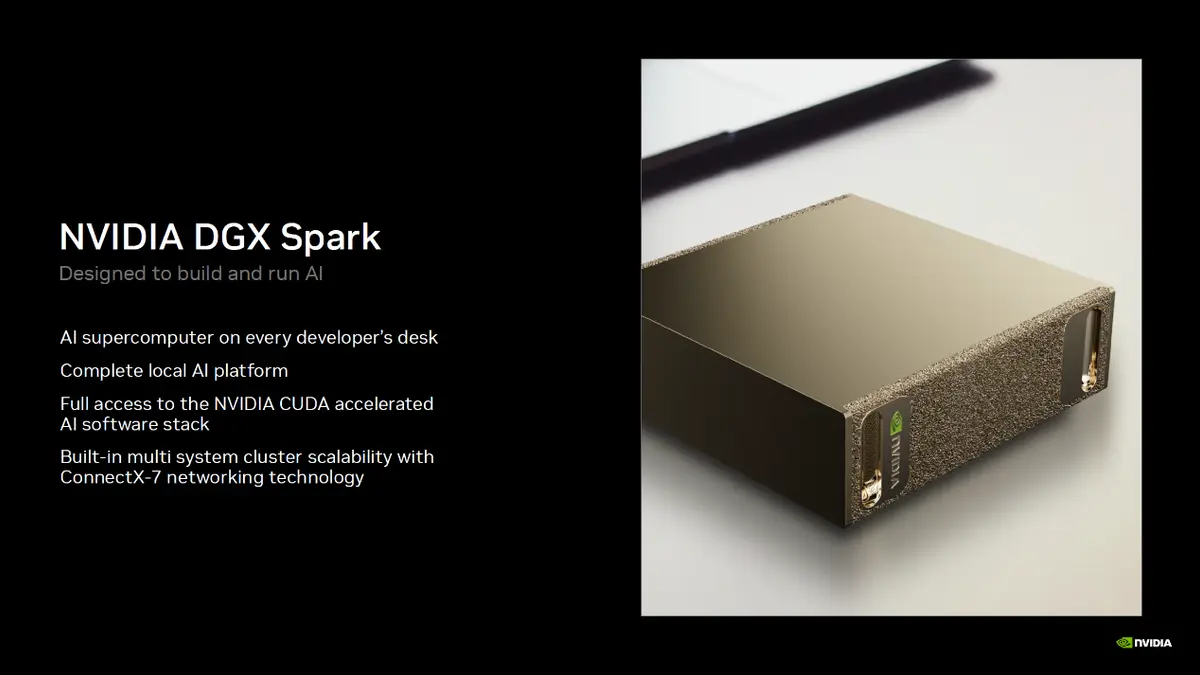
Nvidia has quietly redrawn the line between a workstation and a data center. On October 2, the company announced a 64GB memory version of its DGX Spark desktop AI computer, priced at $4,999, with the first units shipping on October 23. A higher-spec 128GB Founders Edition was repriced at $6,950.
The machine is built around the GB10 Grace Blackwell superchip, a processor that packs a CPU and a GPU onto a single piece of silicon. That design lets the Spark run large AI models locally, without renting time on a remote cloud server. Nvidia pitches it as a personal AI computer: a box that sits next to a monitor and trains, fine-tunes or serves models that would once have required a rack of equipment.
The most interesting detail for global buyers is who will actually assemble the thing. Nvidia is not selling alone. Acer, Dell, Asus, Gigabyte, MSI and H3C are all preparing complete systems on the same platform. H3C, a major Chinese computing and networking vendor, gives the product a direct route into China’s developer and research market, where access to top-tier AI hardware has become a practical concern for many teams.
The appeal is straightforward. A researcher or small studio can buy one box, plug it in, and experiment with models measured in tens of billions of parameters. For startups that cannot justify cloud bills that scale with every experiment, a fixed-price machine that lives under a desk changes the economics of trying things. It also keeps sensitive data on premises, a point that matters to hospitals, law firms and anyone handling material they would rather not upload.
The timing is telling. AI work has shifted from a handful of giant labs toward a much wider field of companies and universities, and hardware makers are racing to serve that long tail. Nvidia’s move follows a broader pattern in which the personal computer is being redefined around local AI processing rather than raw office productivity. The Spark is an expensive, specialist version of that idea, but it points where mainstream laptops are already heading.
There are limits. Five thousand dollars buys a lot of cloud compute, and the Spark cannot match a full data center for the largest training runs. Its real value is iteration speed and privacy, not raw scale. Buyers also need to weigh memory: the 64GB model will handle many workloads, but the 128GB edition exists for a reason, and the gap in price reflects a gap in capability.
For China’s hardware ecosystem, the launch is another reminder that the desktop is becoming an AI battleground. Local manufacturers get a ready-made platform to sell into universities, hospitals and private firms, while global rivals compete on the same silicon. The winners will be decided less by raw specifications than by software support, cooling, noise and the unglamorous work of making a powerful machine pleasant to live with.
Whether a desktop supercomputer becomes a common sight or stays a niche tool for specialists is now an open question. What is clear is that the distance between a research lab and a home office just got a lot shorter.