Why the Moon Looks Huge in Photos—and Tiny in Real Life
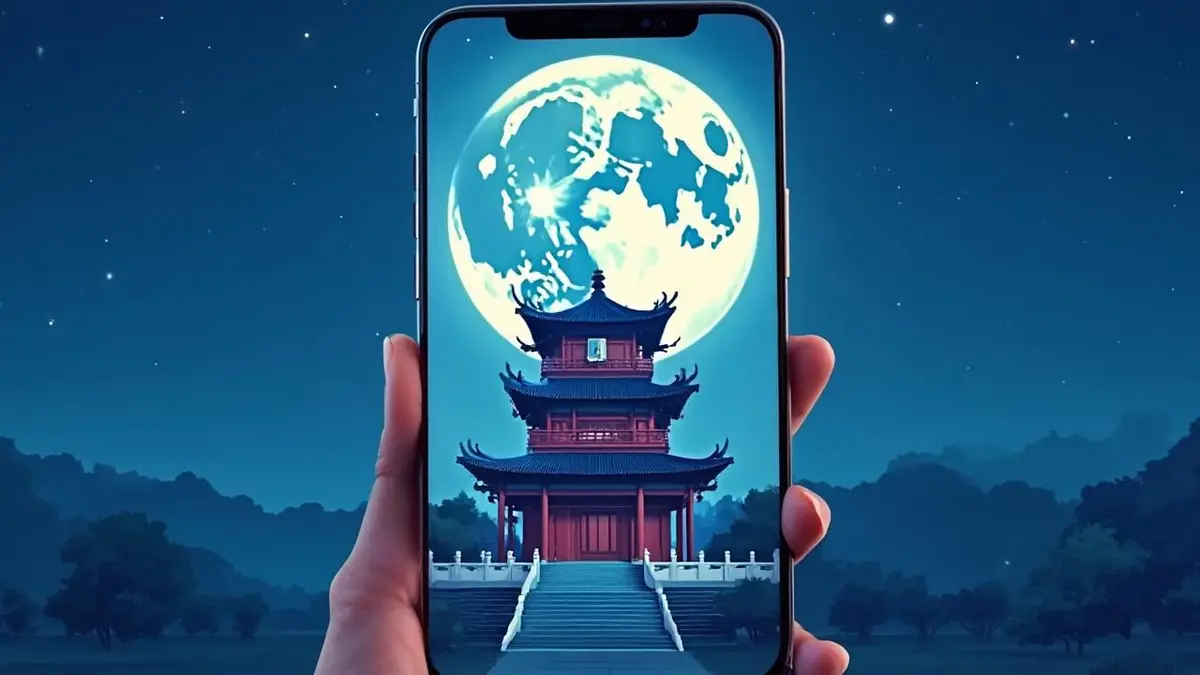
Every autumn, when China celebrates the Mid-Autumn Festival, millions of people step outside to admire the full moon. Many raise their phones to capture it, then stare at the result with disappointment: a bright little dot floating in a sea of black. Yet the same moon, photographed by someone else, appears enormous, detailed and cinematic. How can one moon look so different in three places—the sky, your phone and your friend’s social media feed?
The answer begins with a simple fact about optics. A phone camera’s standard lens captures a much wider field of view than the human eye does when it focuses on a single object. The moon occupies a tiny fraction of that frame, so it shrinks to a speck. Professional photographers get around this with long telephoto lenses, which compress the scene and make the moon appear larger relative to foreground objects. That is why a photo of the moon behind a pagoda or a city skyline can look dramatic while a bare moon shot looks dull.
Exposure is the second problem. The moon is lit by direct sunlight, so it is extremely bright against a dark sky. A phone left on automatic mode tries to balance the whole scene, overexposing the moon into a white blob while the surrounding sky stays black. Skilled astrophotographers manually lower the exposure, sometimes using a tripod and a delayed shutter, to reveal craters and maria—the dark plains formed by ancient lava flows. Modern phones increasingly offer a dedicated moon mode that recognises the shape and adjusts settings automatically.
Then there is the human factor. When you look at the moon low on the horizon, your brain compares it with trees, buildings and hills, creating the famous moon illusion that makes it seem enormous. A camera has no such bias. It records only angles and light. The gap between perception and measurement is one of the oldest puzzles in visual science, and it explains why the moon in your memory rarely matches the moon in your gallery.
This year’s festival chatter online has been full of gentle humour about the mismatch. One widely shared essay joked that you say the moonlight is beautiful, and your friend replies, ‘Where? I don’t see it.’ The frustration is universal, but the fix is surprisingly accessible. Astronomy educators recommend shooting when the moon is near the horizon, placing a recognisable landmark in the frame, turning off flash, tapping the screen to lock focus on the moon, and dragging the exposure slider down until surface detail appears.
For those who want more, a basic tripod and a telephoto attachment can transform a phone into a respectable lunar camera. Telescope makers and camera brands in China have noticed the seasonal interest, promoting beginner-friendly gear ahead of the festival each year. Amateur astronomy clubs also organise public viewing nights, where visitors can see the moon through real optics and compare it with their own screens.
The deeper lesson is about trust. We tend to assume a photograph tells the truth, but every image is a set of choices: lens, exposure, timing, framing. The moon is a useful teacher because it is the same object for everyone on Earth, yet it can be rendered as a dot, a disc or a glowing giant. Understanding why does not ruin the romance of moon gazing. If anything, it adds a second layer of wonder—one about light, eyes and the quiet engineering inside the device in your pocket.