Huawei and China Southern Power Grid Sign Deal to Rewire the Equipment Market
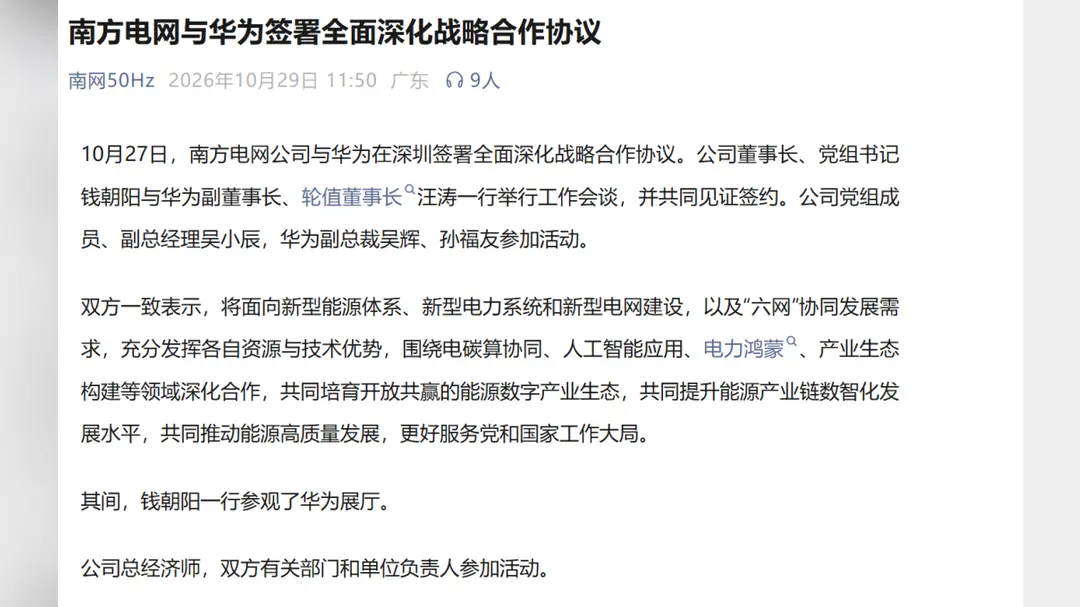
China Southern Power Grid, one of the two state-owned companies that run the country’s electricity transmission and distribution networks, has signed a major cooperation agreement with Huawei, according to a report from tech outlet TMTPost. The two sides described the deal as a deepening of their existing partnership, and the coverage frames it as a moment when the rules of the grid equipment market may be about to change.
The story lands in a sector that global readers rarely see up close. China’s power grid is the largest in the world by installed capacity and transmission length, and it is also one of the most digitized. Southern Grid covers five southern provinces and regions, including Guangdong, Guangxi, Yunnan, Guizhou and Hainan, and has spent years installing smart meters, sensors and communications gear across its network.
Huawei is not a conventional grid equipment maker. Its role has been in the digital layer: chips, operating systems, cloud services and communications modules that let utilities collect and move data. Pairing that with a utility’s physical assets is the kind of combination that can reset procurement standards. If Southern Grid and Huawei agree on technical specifications together, smaller equipment suppliers may find that the bar for compatibility has moved.
The report’s framing is that equipment vendors will have to adapt to a different way of doing business. That is a common pattern in China’s state-led infrastructure sectors, where a large buyer and a large technology partner can set de facto standards that ripple down the supply chain. Vendors that once competed mainly on hardware price may now need software and data capabilities to stay on the approved list.
For Huawei, the agreement is another step in a long campaign to sell into industries beyond consumer electronics and telecom carriers. The company has pushed into autos, mining, ports and energy in recent years, often through partnerships rather than direct equipment sales. Grid work fits that pattern: it is heavy on reliability requirements, long procurement cycles and deep integration with the customer’s operations.
The timing is notable. China’s power system is under pressure to absorb more renewable energy, manage peak demand and connect far-flung generation to city loads. Digital monitoring and control are increasingly seen as necessary rather than optional. A closer tie between a major grid operator and a major technology supplier is one way to speed that up, though it also concentrates influence in fewer hands.
What remains unclear is the scope. The report does not spell out the size of the contract, the specific projects involved or how exclusive the arrangement is. Those details matter for the many suppliers that build transformers, switchgear, cables and monitoring systems for Southern Grid. For now, the signal is directional: the boundary between utility and technology company is getting thinner.
For global readers, the story is a reminder that China’s energy transition is not only about building solar farms and wind turbines. It is also about the software and communications layer that keeps the grid stable. Deals like this one shape which companies get to build that layer, and how much of the equipment market they influence.