Why AI Still Can't Leave the Screen, Says Shanghai Professor
Most of what large language models do well still happens inside a screen. They read, write, translate, draft code and call digital tools. Ask one to move a crate across a factory floor, and the problem changes shape: now the system has to deal with objects, space, force and time, and it has to live with the consequences of what it does.
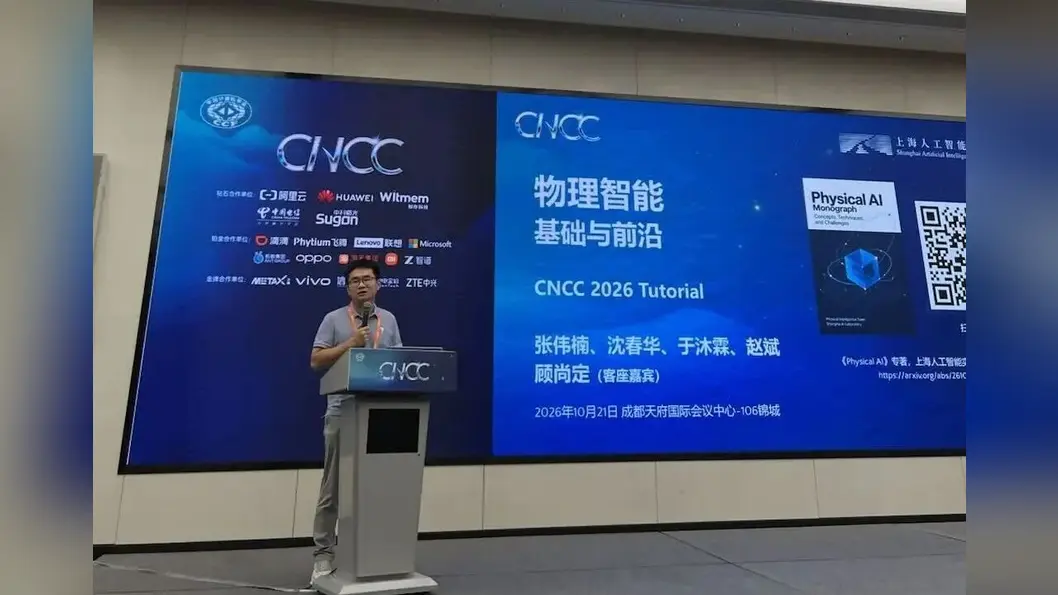
That gap was the subject of a talk by Zhang Weinan, a professor at Shanghai Jiao Tong University, at CNCC 2026, a major Chinese computing conference. His argument, reported by Leiphone, is that the next frontier is physical intelligence — AI that closes a loop of sensing, prediction, action and continued learning in an environment that will not pause for it.
The digital world is forgiving in ways people rarely notice. A chatbot that produces a bad answer can be re-prompted; a model that fails a coding test can try again. A robot arm that misjudges a grip has already dropped the part. Zhang’s framing puts uncertainty and irreversibility at the center: the real world is full of situations the training data did not cover, and the cost of a wrong move is often paid immediately.
That makes the engineering harder at every layer. Perception has to hold up under bad light and clutter. Prediction has to run fast enough to be useful before something falls. Action has to be safe when the system is not sure. And learning cannot stop at deployment, because factories, labs and city infrastructure keep changing around the machine.
The research conversation around this is already visible in China’s robotics community. CoRL, the Conference on Robot Learning, opens in Austin, Texas, on November 9, and Leiphone notes that its accepted-paper count has grown roughly four and a half times over six editions, with Chinese universities rising quickly alongside established American groups. Robot learning has moved from a niche to one of the busiest intersections of AI and hardware.
The commercial pull is equally strong. Chinese companies now ship humanoid robots and robot dogs at prices that would have seemed implausible a few years ago, and investors have poured money into world models — systems that learn how physical scenes evolve — as a way to give machines a cheaper rehearsal space before they touch anything real. Simulation is attractive precisely because failure there is free.
Zhang’s point is not that the screen work is finished. It is that the easy part of AI’s public story has been the part that never has to touch anything. Moving intelligence into factories, laboratories and urban systems means accepting a different contract: the machine must act under uncertainty, and the world will not offer a reset button. For an industry that has spent a decade optimizing text, that is a genuinely new kind of problem.