A Tourist Paid $84 to Enter China's FAST Telescope Core Zone
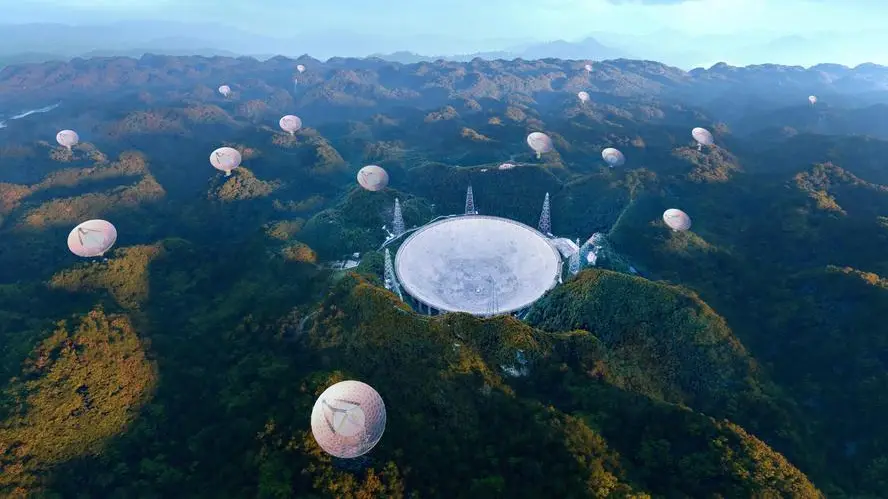
A tourism listing offering a “deep science experience” at China’s giant radio telescope has triggered a public outcry after reporters found that paying customers could drive straight into the facility’s protected core, past two security checkpoints that appeared to wave them through without inspecting phones or luggage.
The telescope at the center of the story is FAST, the Five-hundred-meter Aperture Spherical radio Telescope, known in Chinese as Tianyan, or “Sky Eye.” It sits in a natural basin in Pingtang County, Guizhou Province, in southwestern China, and its 500-meter dish makes it the largest single-dish radio telescope on Earth. Because it listens for faint signals from deep space, the surrounding valley is designated a radio quiet zone, where transmissions that could drown out cosmic noise are tightly restricted.
According to the reports, a visitor paid 598 yuan, roughly 84 US dollars, for a package marketed as a “deep popular-science experience.” After that purchase, the account says, private vehicles only needed to register a license plate at the gate before being allowed to continue into the electromagnetic quiet zone’s inner area. Two inspection points that are supposed to screen for phones, cameras and other electronic devices reportedly let the car and its occupants pass unchecked.
The most striking detail concerns accommodation. A hotel inside the core zone was said to be selling rooms at 2,688 yuan a night, with the rate tied to a quota for what the listing described as a close-range look at the telescope’s ring beam structure. That framing suggests access to a restricted scientific site was being packaged and sold as a premium tourist perk rather than managed as a research necessity.
The story spread quickly online, and the question dominating discussion was simple: who opened the gap? The telescope is a national research facility, and its quiet zone exists for a reason. Unauthorized electronics inside the protected radius can interfere with observations, and the rules are meant to apply to everyone, from visiting scientists to day-trippers.
For travelers, the episode highlights a familiar tension in China’s fast-growing science tourism sector. Landmarks like FAST draw huge numbers of curious visitors, and local economies around them want to capture that spending. Official visitor centers and viewing platforms are designed to let people experience the site without entering sensitive areas. Unofficial or loosely managed packages blur that line, and the higher the price, the more incentive there is to promise something exclusive.
The reports also raise practical questions about oversight: whether tour platforms vet the access they advertise, whether gate staff have the authority and training to turn vehicles away, and whether hotel operators inside restricted zones should be able to bundle viewing privileges into room rates at all. Calls for a thorough investigation followed, with commentators arguing that any loopholes need to be closed rather than quietly tolerated.
FAST has become a point of national pride and a genuine scientific asset, credited with discovering hundreds of new pulsars since it began operating. Its value depends on keeping its surroundings radio-quiet. That makes the reported lapse more than a customer-service complaint. It is a reminder that when a research facility doubles as a tourist attraction, the boundary between the two has to be enforced, not sold.