Chinese Actress Exposes AI Deepfake Selling Skincare in Her Name
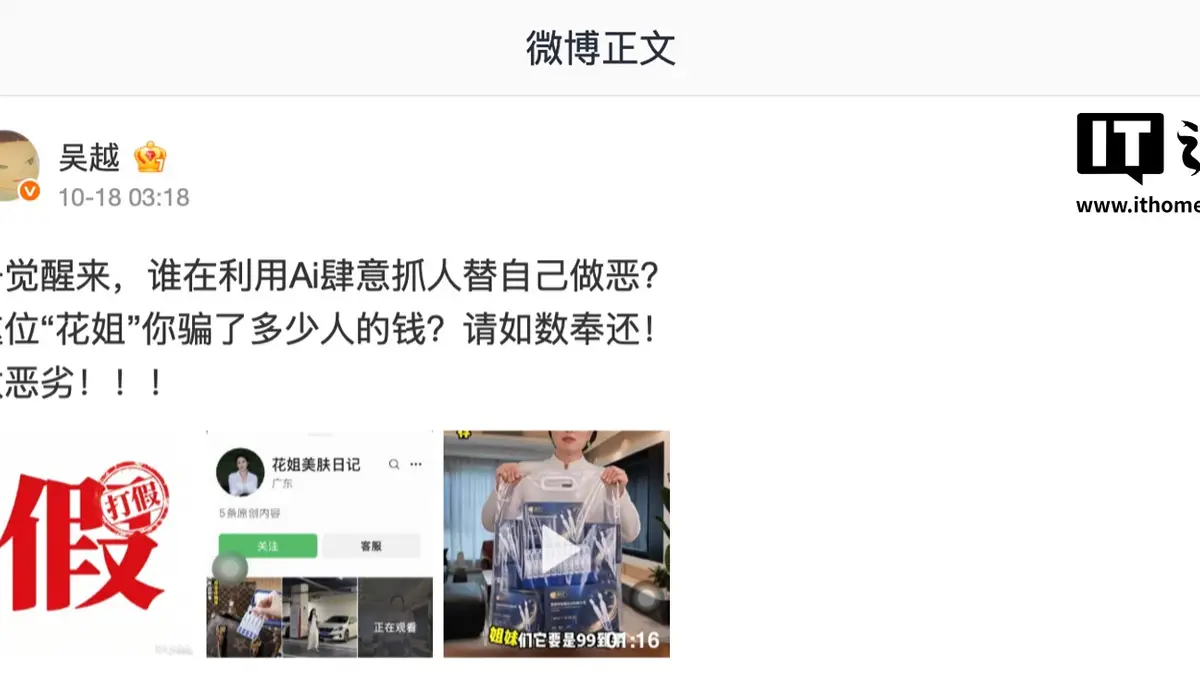
Chinese actress Wu Yue did not have to read a scandalous headline to learn she had been “hired” to sell skincare. She simply woke up to it. In the early hours of October 18, the stage and screen performer posted a video on social media asking who had used AI to clone her voice and face for a livestream-style sales pitch. “Who is using AI to grab people and do evil in my name?” she wrote, addressing the account operator directly and demanding that money taken from viewers be returned.
The account in question, a WeChat Channels page called “Sister Hua’s Skincare Diary,” had published a clip in which a synthetic “Wu Yue” opened the video by endorsing a product. The video then cut to genuine public-event footage of the actress, paired with a cloned voice claiming that she was working with a manufacturer to give fans a special deal. The pitch leaned on the familiar language of celebrity fan welfare, the sort of phrasing that persuades viewers to trust a product without questioning it.
Wu Yue’s response was swift and public. She posted screen recordings of the fake clip and asked pointedly how many people the operator had cheated and how much money had been collected. Within hours, WeChat Channels said it had permanently banned the account and cleared its content. The platform’s statement, reported by Chinese tech outlets on October 19, confirmed the takedown but offered no detail on whether refunds would follow or whether the operator faced further action.
The incident is a vivid example of how cheap, convincing AI video has moved from novelty to nuisance to outright fraud. Cloning a recognizable face once required a studio and a budget. Today it takes a handful of publicly available photos, a few seconds of recorded speech and a consumer-grade tool. Celebrities are attractive targets because their faces carry built-in trust, and skincare, supplements and health products are attractive products because margins are high and buyers are often older viewers who may not recognize the tells of a synthesized clip.
China has been tightening rules around this. Regulations on deep synthesis, introduced in recent years, require that AI-generated content be clearly labeled and that platforms verify the identity of users who produce it. Enforcement, however, has lagged behind the tools. Scams often surface on short-video and livestream platforms where sales happen fast, accounts can be recycled and victims rarely report losses because the sums are small and the embarrassment is large. Actress impersonation cases have cropped up repeatedly, with performers from film, television and sport finding their likenesses attached to products they have never touched.
For Wu Yue, the episode ended with the account gone. For the broader problem, the lesson is less tidy. Detection tools are improving, and platforms are under pressure to act quickly when a public figure speaks out. But the economics still favor the scammers: a single convincing clip can run for hours before anyone notices, and the cost of making another is close to zero. The actress’s demand that the money be returned may be the hardest part of all.