A Suit of Armor: Why Shenzhen School Uniforms Cost Pocket Change
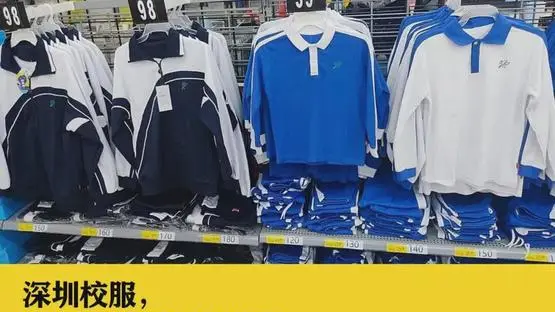
For most Chinese students, the school uniform is a daily negotiation. In many cities it is ordered through the school, priced by a committee and delivered once a year, which makes it expensive, rigid and slightly precious. Shenzhen does it differently. There, students and parents can simply walk into a supermarket and pick a uniform off the rack for a few dozen yuan, the way you would buy a T-shirt. A viral essay from the science account Guokr dug into why the southern tech hub treats its school uniform as a cheap commodity rather than a ceremonial garment.
The short answer is procurement. Shenzhen standardized the design across the whole city years ago and then let the market handle production and retail. Because every school uses the same recognizable pattern, factories can make them in enormous volumes, and competition keeps prices low. Parents do not wait for a school notice; they buy replacements whenever a child outgrows one. The uniform stops being a symbol of institutional authority and becomes ordinary clothing.
That cheapness changes how students treat it. The essay’s author recalls the small acts of rebellion that turned a plain polyester shell into something personal: trimming the cuffs, pulling the elastic out of the trouser hems, cutting away the mesh lining so only a thin outer layer remained, then drawing a few small flowers on the back with a marker. The rules said one thing; the scissors said another.
There is a practical logic to the fabric itself. Shenzhen is hot and humid for much of the year, so a light, quick-drying synthetic layer makes sense. It is also forgiving. A uniform that costs little can be stained, stretched, lost and replaced without a family argument. When the stakes are low, teenagers feel freer to experiment with it, and the garment absorbs a phase of life that is otherwise tightly scheduled.
Nationally, school uniforms are a surprisingly large market, and debates about price, quality and who profits from them surface regularly. Some cities have tried to copy Shenzhen’s model, only to find that standardization is the hard part. A common design only works if parents, schools and suppliers all accept it, and if enough factories compete to keep it cheap. Without that, a uniform reverts to being a monopoly purchase.
The essay is nostalgic, but its point is institutional. A uniform is a small piece of public policy you wear against your skin. Make it affordable and easy to replace, and it becomes background noise, which is arguably what clothing for teenagers should be. Make it expensive and mandatory, and every tear becomes a family expense and every rule becomes a fight.
Shenzhen’s version also blurs a social line. When everyone wears the same cheap jacket, the label on your back says less about your family’s income. That is not a cure for inequality, but it is a quiet daily equalizer, and it costs the city nothing beyond a willingness to let shops, not committees, set the price.
So the next time a Chinese student complains about a uniform, the complaint may be a compliment. In Shenzhen, the uniform is cheap enough to customize, cheap enough to ruin and cheap enough to forget. The flowers drawn on the back are not defiance of a costly institution; they are just a teenager making something plain a little bit theirs.